

If your time is short:
-
The traditional fly-in-for-a-weekend advisory board leaves enormous value on the table. Here are four plays we use at ExtendMed to get dramatically better results.
-
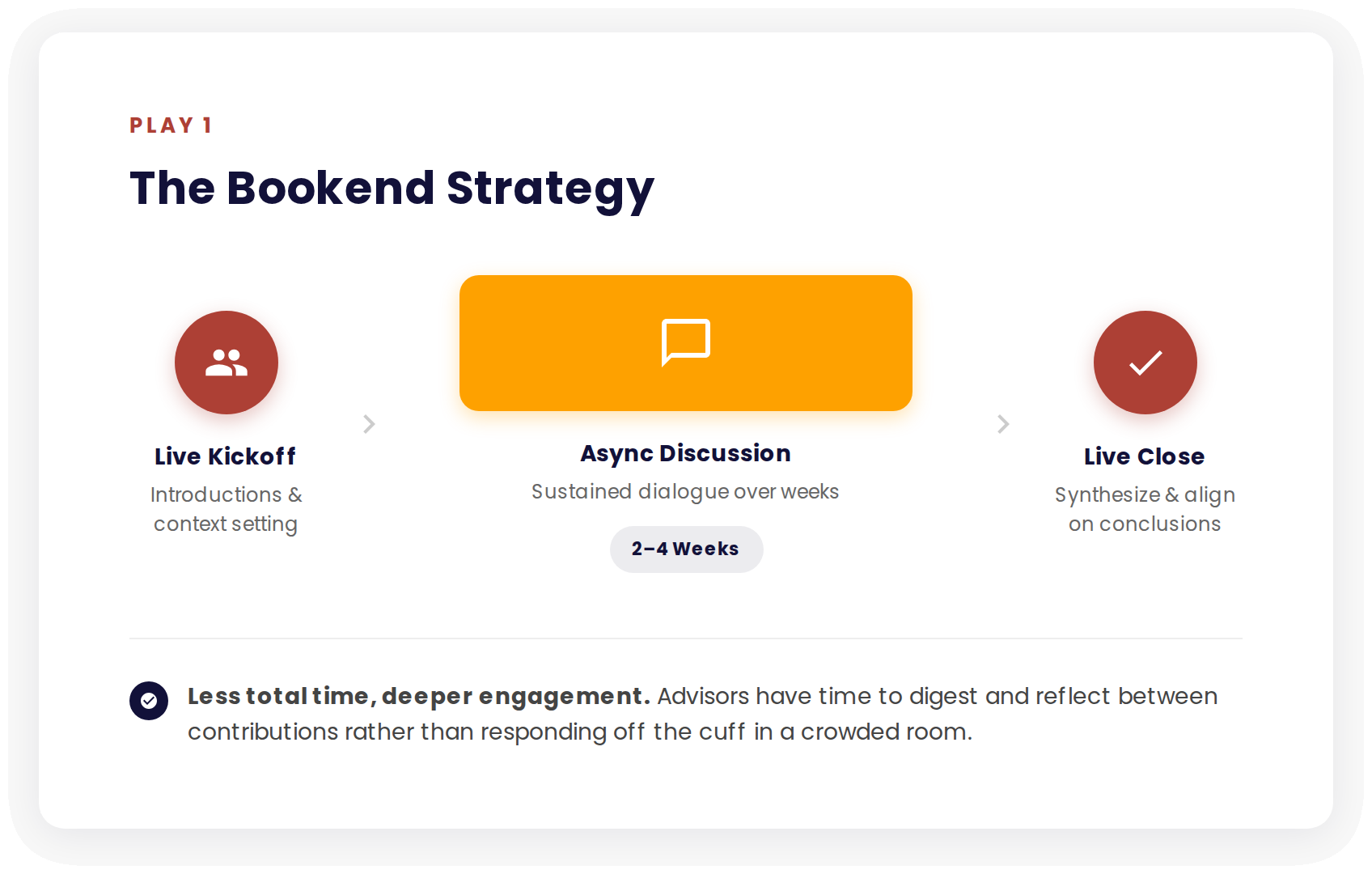
The Bookend Strategy frames weeks of asynchronous discussion between two live meetings—building trust upfront and synthesizing at the close.
-
The Cross-Pollination Play keeps specialists from different disciplines together instead of siloing them, so ideas travel across therapeutic areas.
-
The Multi-Modal Sequence layers discussion forums, surveys and interviews in a deliberate order because each modality reveals something the others miss.
-
And The Active Moderator Play puts a subject matter expert in the moderator seat who probes and follows up daily—not someone who just says "thank you, that was useful" and moves on.
-
Every one of these plays comes from real client work.
After more than two decades of facilitating advisory boards for pharma and biotech companies, ExtendMed has learned that the difference between a productive engagement and a forgettable one almost never comes down to the topic or the caliber of the advisors. It comes down to the design.
Too many teams still treat advisory boards as a single event: fly people in for a weekend, sit in a conference room, go through a slide deck and call it done. And then six months later they do it all over again. The insights are thin, the follow-up is scattered and the advisors themselves walk away feeling like their time could have been better spent.
What I want to share here are a few specific engagement strategies (think of them as plays in a playbook) that we've refined through real client work and that consistently produce richer results than the traditional approach. These aren't theoretical. We've used them with clients, and they work. In each case, I want to be honest about what makes them possible from a tooling and infrastructure standpoint, because the strategy is only as good as your ability to execute it.
Play 1: The Bookend Strategy
The Bookend Strategy is the approach I'm most passionate about. The idea is simple, but the impact is significant.
Instead of trying to cram everything into a single meeting, you frame a multi-week asynchronous discussion period with two live synchronous sessions: one at the beginning and one at the end. Those two live meetings are the "bookends" that hold everything together.
Here's how it works in practice:
- The opening meeting is a meet-and-greet. The leadership team introduces itself, and the advisors introduce themselves. They share their backgrounds and clinical interests so that everyone knows who they're engaging with before the deeper work begins.
- Then the sponsoring team lays out the research project: where things stand, what the roadblocks are and what they want to get out of the engagement. That first session sets the stage.
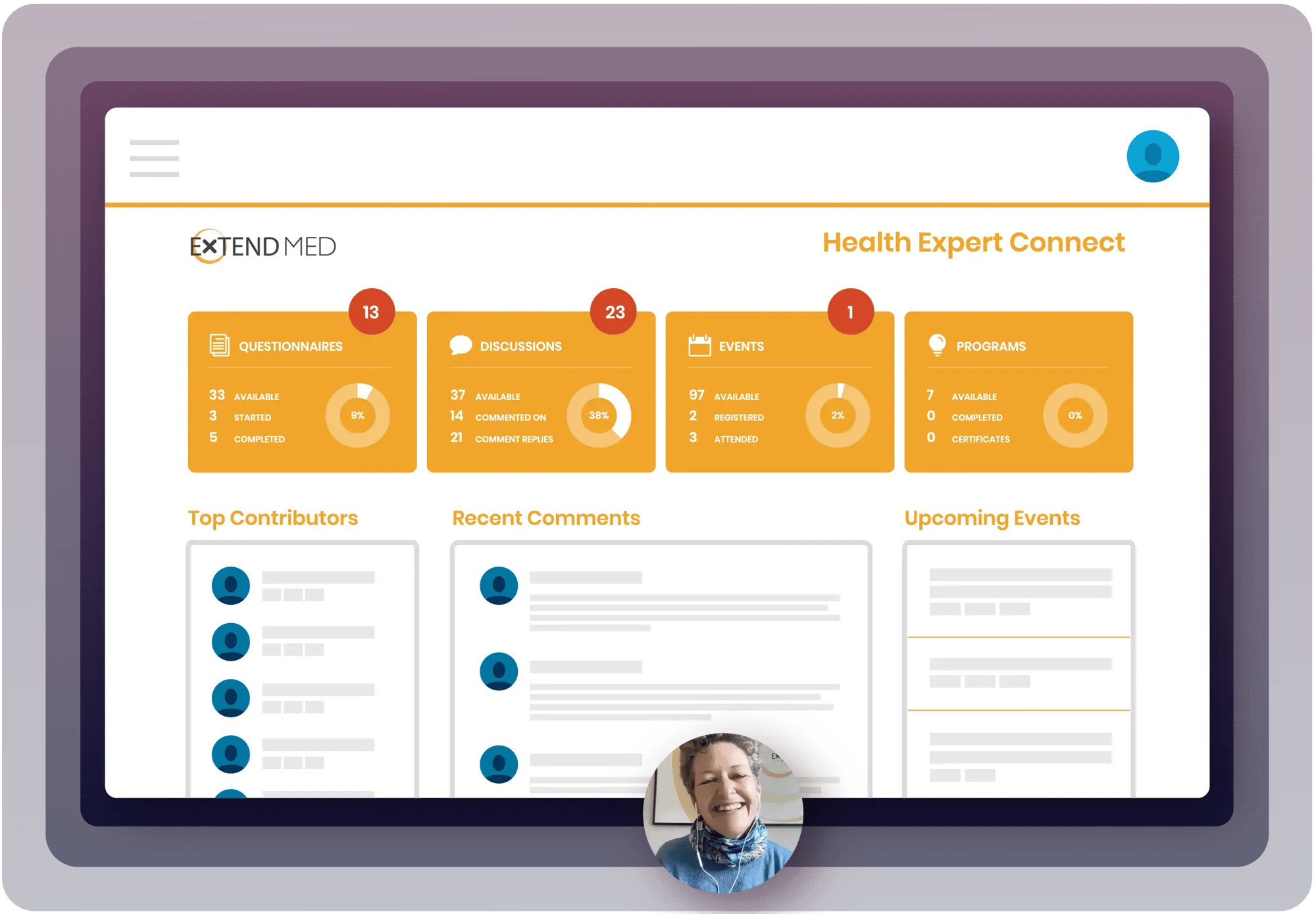
- Then, for the next several weeks, the advisors move into asynchronous discussion on our Health Expert Connect™ platform. This is where the meat of the work happens. Questions are posted to structured discussion boards. Advisors come in on their own time and contribute thoughtful responses. And critically, they can read and build on what others have said.
- Threaded conversations let people reference evidence, attach files and develop ideas collaboratively. It's not a two-hour window where someone has to compete for airtime. It's sustained dialogue.
- The closing session brings everyone back together to synthesize, debate and align on conclusions.
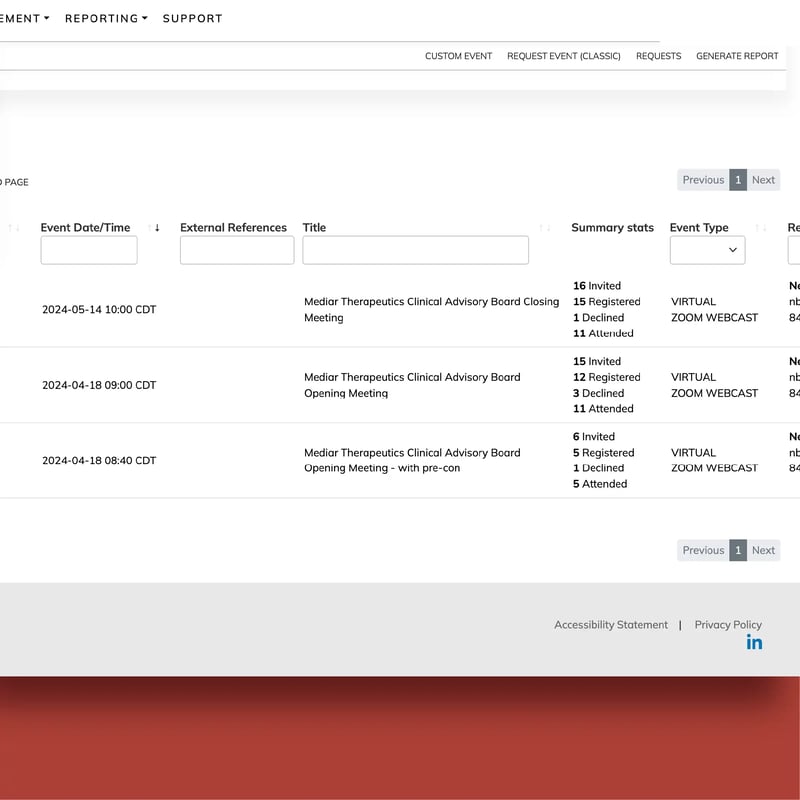
We saw this play out powerfully in our work with Mediar Therapeutics. Their Chief Medical Officer, Dr. Jeffrey Bornstein, came to us to convene a multidisciplinary group of specialists to help prioritize indications for fibrosis-targeting drugs across three therapeutic areas. He initially envisioned a purely asynchronous engagement segmented by specialty. We recommended something different.
We guided him to keep the advisory board cross-functional: hepatologists, rheumatologists, pulmonary specialists and a former FDA employee, all working together rather than siloed. And we structured it as a bookend engagement with introductory and closing live meetings, framing a three-week asynchronous discussion.
The results spoke for themselves. Advisors contributed an average of five hours each, with some providing over 25 individual insights. The cross-disciplinary conversations surfaced ideas that never would have emerged from siloed specialty discussions. And Dr. Bornstein, because he was personally moderating the asynchronous discussions and sending targeted follow-up questions almost daily, drove a depth of engagement we rarely see.
As Dr. Bornstein told us:
"We needed a more involved approach with flexible contract terms and a team to augment our in-house resources."
What we love about the Bookend Strategy is that it respects everyone's time. The total commitment from advisors is actually less than it would be if they had traveled to a weekend advisory board in New York. Yet they develop richer relationships because the engagement stretches over weeks.
The quality of thinking is also better because people have time to digest and reflect between contributions rather than responding off the cuff in a crowded room.
Why this is hard to do without a dedicated platform
Try running a three-week asynchronous discussion across ten specialists using Zoom and email. You can't. You'd host a Zoom call for the opening meeting and that part would be fine. But then what? You send out questions via email and people reply individually to you, not to each other.
- There's no shared space where an advisor can read what a colleague said and build on it.
- There's no way to track who has engaged and who hasn't.
- There's no resource center where they can review pre-read materials with one click.
- And when the three weeks are up, you're manually compiling responses from scattered email threads and trying to piece together a coherent narrative for the closing session.
On Health Expert Connect™, the entire arc of the engagement—the live meetings, the discussion boards, the surveys for scheduling, the resource centers for materials, the email and text reminders, the participation tracking—all live in one place.
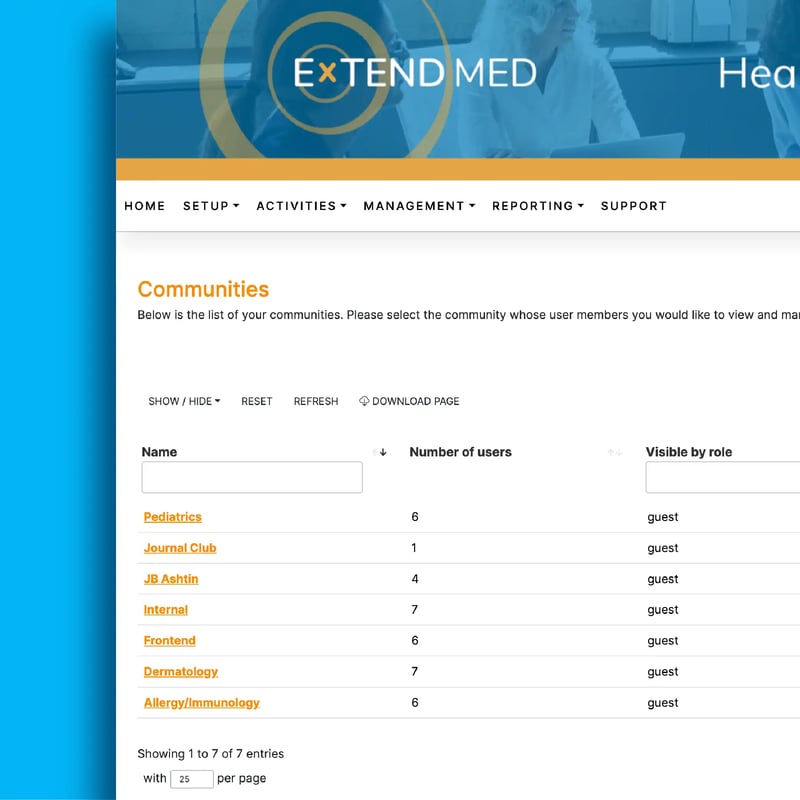
The advisors get a single login. You get a single view of everything that's happening. And when Dr. Bornstein needed a new feature mid-engagement (targeted questions directed at specific advisors) our team developed and implemented it in less than a week. That's what makes the Bookend Strategy work at scale.
Play 2: The Cross-Pollination Play
The Cross-Pollination Play is closely related to the Bookend Strategy, but it deserves its own spotlight because I see so many teams try it (or something close) and stumble.
The instinct when you have advisors from different specialties is to separate them. Run the pulmonologists in one group and run the hepatologists in another in order to keep things tidy.
However, that instinct is often counterproductive. When you keep specialists in their silos, you get predictable answers. When you mix them, something else happens: they pollinate ideas across disciplines, and you get breakthrough thinking that nobody saw coming.
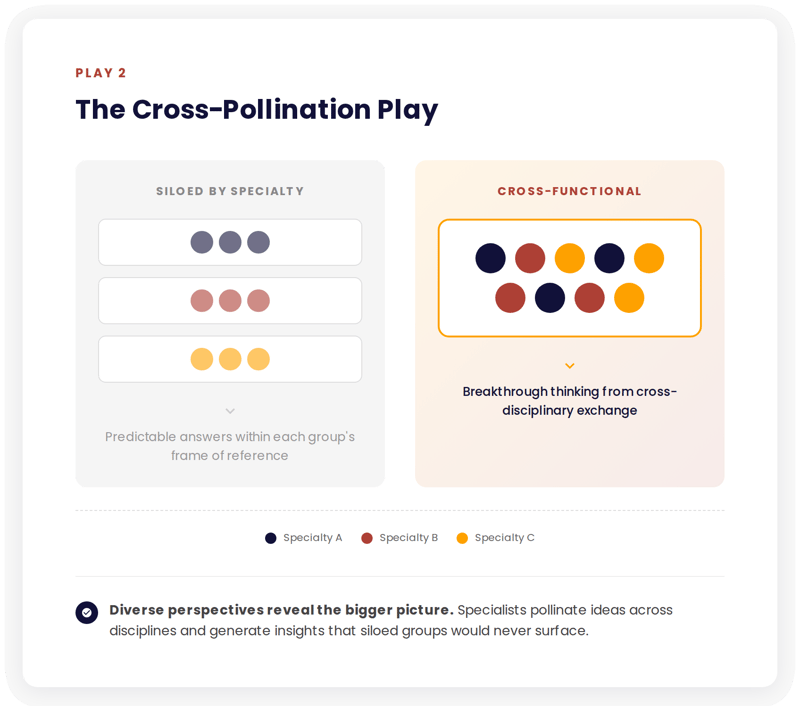
Here’s how I think about this play in practice: Imagine you're running an ad board to understand why your health system isn't getting certain specialist referrals at the right time.
-
If you ask only a group of community cardiologists for their perspectives, you're revealing only part of what's likely a much bigger picture.
-
To understand the root of the problem, you might instead want to hear from a leading cardiologist running multiple clinical trials at an academic medical center and then intersperse those insights with feedback from the community cardiologists.
-
Now you're revealing much more about the referral problem from multiple angles.
You simply wouldn't get to that insight if you only had one group together.
The key here is being intentional about composition. We help our clients think about their objectives in different ways and then pull together a group of advisors that may have diverging interests and diverging experiences, and a diversity of perspectives that produce richer results.
Why this is hard to do without the right infrastructure
Cross-pollination requires a shared environment where specialists from different disciplines can actually see and respond to each other's thinking.
In a traditional in-person meeting, you get maybe two hours, and whoever talks loudest dominates the conversation—the quieter voices get lost. In an email chain, you'd have to CC everyone on everything, which quickly becomes unmanageable and violates most compliance protocols.
Our platform's community features let you organize participants into the right groups while keeping everyone's contributions visible in structured discussion threads. You can segment by specialty when you need to, but more importantly you can bring them together in a single discussion space where a rheumatologist can read a pulmonologist's response, think about it overnight and post a challenge or build the next day.
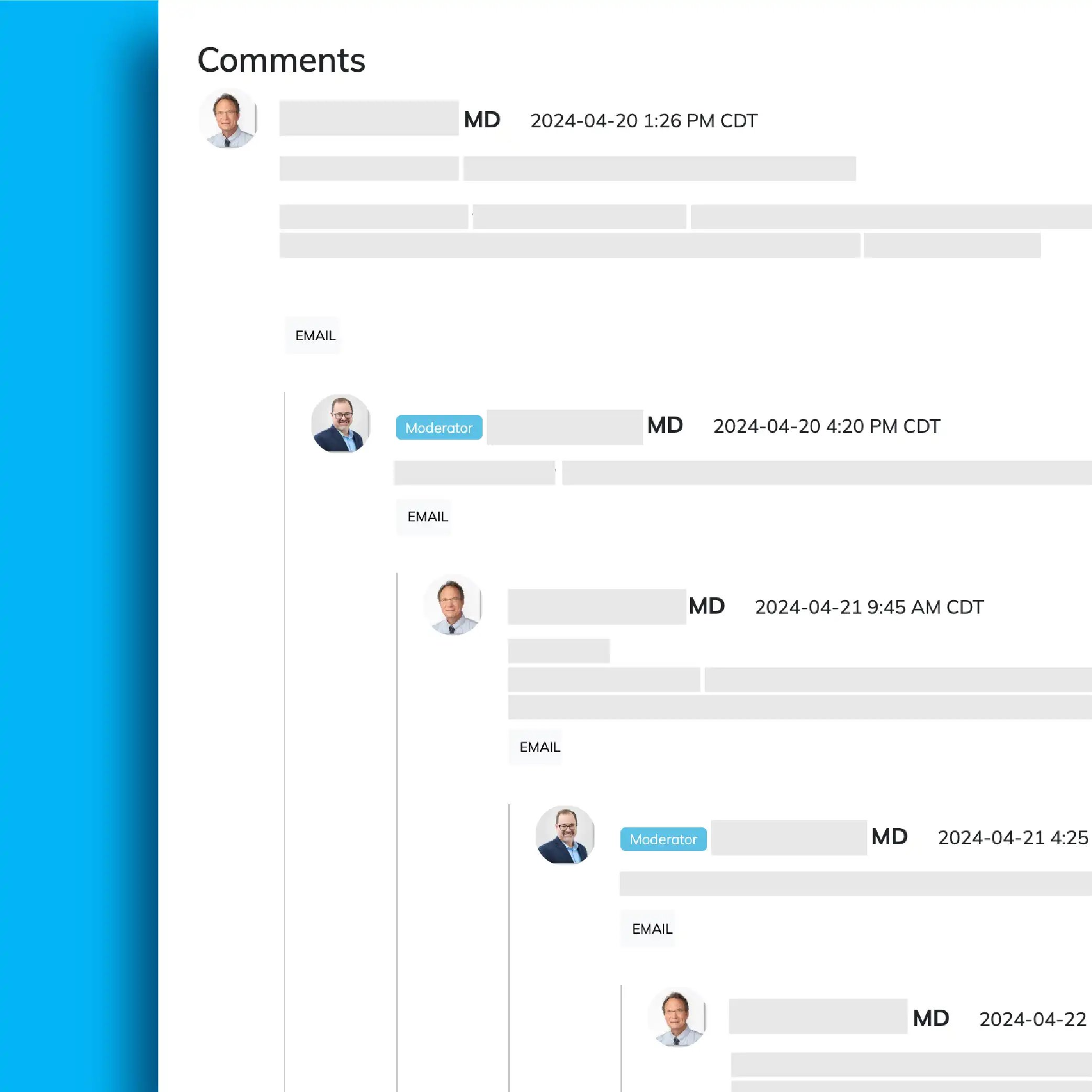
Everyone sees each other's contributions in real time. Activity feeds ensure every voice is heard equally, regardless of participation style or time zone. That kind of deliberate cross-functional dialogue simply doesn't happen without a shared, persistent space designed for it.
Play 3: The Multi-Modal Sequence
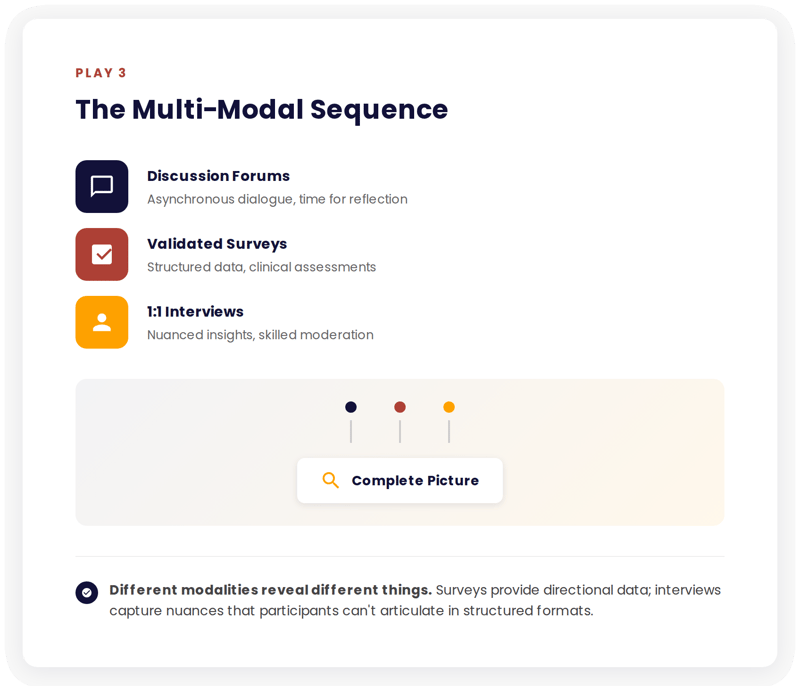
Sometimes a discussion board alone isn't enough. Sometimes a survey alone isn't enough. The real insight comes from layering different engagement modalities in a deliberate sequence—and paying attention to what each one reveals differently.
We saw this most clearly in our work supporting a patient-experience data-collection project for an FDA submission. The disease was CSF1R/ALSP, a rare and severely progressive condition. The stakes were as high as they get—this data would directly support an FDA submission for a treatment that families were desperately waiting for.
Working with our partner Imbue Partners and their client, we designed a three-pronged approach.
- First, we stood up online discussion forums with completely separate spaces for patients and caregivers. That separation was critical — caregivers needed the freedom to speak honestly about the burden of care without worrying about upsetting their loved ones. And patients needed space to express their own fears independently.
- Second, we deployed validated clinical assessments through online surveys — tools like the Katz Index for activities of daily living and the NPI-12 for neuropsychiatric assessment.
- Third, we coordinated one-on-one interviews with flexible timing to accommodate participants whose cognitive limitations varied dramatically from day to day.
The multimodal approach revealed something that fundamentally changed the team's understanding of research methodology. The responses people gave in the online surveys differed from what emerged in the interviews.
The surveys provided directional data. But the interviews captured nuances that participants didn't necessarily understand how to articulate in a survey — linkages that only a skilled moderator could draw out in conversation.
As Imbue's Gretchen Hover put it:
"We were trying to understand the patient's lived experience through multiple modalities."
And the platform's asynchronous flexibility was essential for this population. People could participate on their good days. If they were having a bad day, they could come back tomorrow.
As Gretchen described it, the technology allowed participants to engage wherever they were and whenever they were ready—and even after the initial prompt window closed, they could go back and add to their contributions over the following weeks.
Maybe the most unexpected outcome was that the platform created a genuine sense of community for families dealing with devastating isolation. People felt connected and heard.
That's when technology actually transcends its purpose. When it not only captures the data you need for an FDA submission but also gives something back to the people sharing their stories.
Why this is nearly impossible with stitched-together tools
Think about what this engagement actually required: separate discussion forums for patients and caregivers, validated survey instruments, coordinated scheduling for one-on-one interviews and a way to track participation and analyze results across all three modalities together.
If you tried to do this with a patchwork of Zoom for the interviews, SurveyMonkey for the assessments and email for the discussion component, you'd have three completely siloed data sets with no way to see how the data from your survey relates to the data from your discussion board. You wouldn't know how often you've engaged each participant across the different touchpoints.
The compliance tracking would be scattered across different systems. And for a population dealing with severe cognitive decline (some caregivers in their 80s) asking them to navigate three different tools with three different logins would be a nonstarter.
On Health Expert Connect™, all of it lives in one branded environment.
- Separate community spaces for patients and caregivers.
- Survey tools that support validated clinical instruments.
- Scheduling and communications for the interviews.
- Resource centers for shared materials.
- Participation tracking across every touchpoint.
Participants have a consistent experience with a single login. The research team gets a unified view of everything. And when you can see all the data in one system, you can do the kind of cross-activity analysis that reveals patterns across different engagement modalities, which is exactly what made this project's findings significant enough to inform an academic manuscript.
Play 4: The Active Moderator Play
I've saved this one for last because it's less about structure and more about people—but it might be the single most impactful thing you can do to improve the quality of your advisory board output.
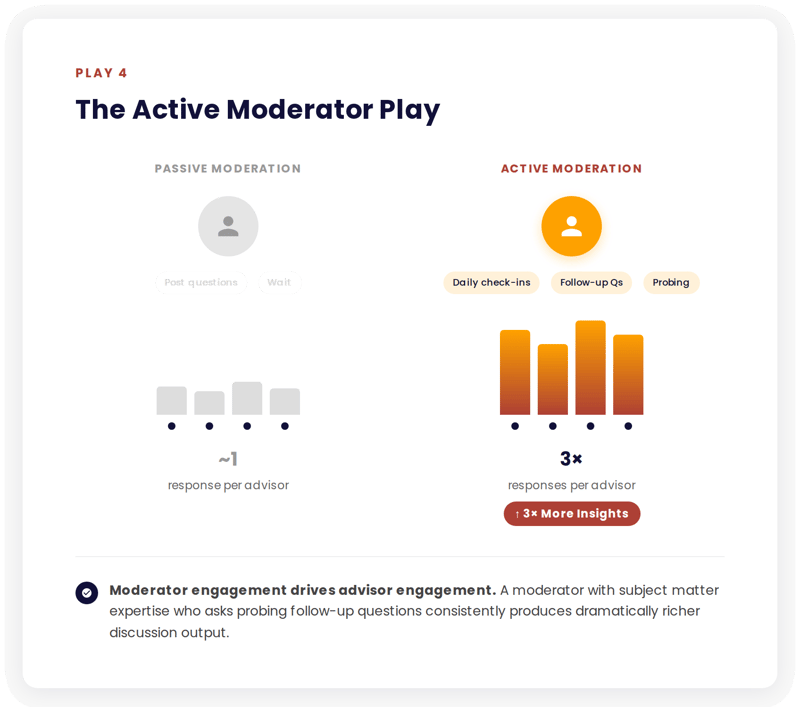
Here's what I've observed over years of facilitating these engagements: The quality of the insights you get is directly correlated to the quality of the moderation. And by moderation, I don't mean someone who says, "Thank you, that was really useful," and moves on. I mean someone who probes and asks open-ended follow-up questions. Someone who is deeply invested in the subject matter and can push advisors to go a layer deeper.
In the Mediar engagement, Dr. Bornstein wasn't just the project sponsor. He was the active moderator. He logged in almost daily during the asynchronous discussion period. He sent out comment alerts and community alerts. He asked specific questions to specific people. And because he was the Chief Medical Officer with deep knowledge of the project, he could drill into responses in ways that a general moderator simply couldn't.
That level of engagement from the moderator drove higher engagement from the advisors. Where we typically see five to ten comments per advisor across a multi-week engagement, his advisors averaged far more than that with some contributing over 25 individual insights.
Not every engagement will have a CMO playing that role, but the principle holds. ExtendMed has seen it work beautifully when a company's PharmD serves as the active moderator in ongoing discussions with nursing staff. Before the PharmD got involved, the client typically received one response per active participant. After the PharmD began logging in regularly and asking pertinent follow-up questions, they started receiving an average of three responses per participant.
The lesson here is clear: If you want deeper discussion from your advisors, you need someone in the moderator seat who has the clinical or subject matter expertise to ask the right follow-up questions — and who is willing to be present and engaged throughout the discussion period, not just at the beginning and end.
We now actively recommend this to our clients. We help them think about who should be involved not just as a formality but as a strategic decision. When the right people are moderating and they're truly invested in the discussions, the results are dramatically better.
An active moderator strategy only works if the moderator has the right tools and visibility. On Health Expert Connect™, the moderator can see at a glance who has contributed and who hasn't through real-time participation dashboards.
They can send targeted questions to specific advisors, not a mass email blast, but a directed prompt to the one person whose perspective is missing from a particular thread. They can trigger email and text reminders with a single click. They can post comment alerts to the whole community when something interesting surfaces.
And our AI-assisted analysis tools help identify themes across discussions, so the moderator can spot emerging patterns and drill into the right areas without reading every single post. All of this means a busy CMO or PharmD can be an effective active moderator in minutes a day rather than hours, because the platform eliminates the logistical overhead.
Without that kind of infrastructure, being an "active moderator" means living in your email inbox, manually tracking who has responded in a spreadsheet, copy-pasting responses between people who can't see each other's contributions and generally spending so much time on logistics that you have no energy left for the actual moderation. The platform removes all that friction so the moderator can focus on what matters—asking the next great question.
Why These Plays Matter
If there’s one thread running through these strategies, it’s this: the traditional advisory board model (infrequent, in-person, siloed, and event-based) leaves too much value on the table. The insights are shallower, the relationships are thinner and the cost, in both time and money, is often higher despite producing less.
These strategies are designed to flip that equation.
- Giving advisors more flexibility, results in more thoughtful input.
- Bringing disciplines together, and you get more creative thinking.
- Layering live meetings, asynchronous discussions, surveys, and resource sharing, and you capture insights no single format would surface.
- Adding active moderation, and the entire engagement deepens.
You can’t execute a modern advisory board strategy by stitching together consumer tools. A Zoom call, a survey link an an email thread do not create a connected program. They create siloed data, compliance risk, frustrated advisors and insights buried where no one can find them six months later.
That’s why we built Health Expert Connect™ as a centralized platform for modern advisory engagement, bringing live meetings, asynchronous discussions, surveys, resource centers, compliance tracking, advisor profiles and participation analytics into one place.
If you’re rethinking your advisory board program, we’d welcome the conversation. We help teams of all sizes—from emerging biotechs running their first advisory board to established pharma teams managing programs across therapeutic areas—design engagements that generate better insights, in less time, and at lower cost. Flexible pilot programs are available so you can see the difference before making a long-term commitment.