If your time is short:
Many (if not most) pharma teams still run their HCP engagement on a patchwork: one tool for video, another for surveys, a third for contracts, spreadsheets for spend and email for everything in between.
Each piece may “work” for what it’s supposed to do, but the seams between them are where insights leak, compliance gaps open and your team's time disappears.
The shift we’re continuing to see accelerate is teams retiring that legacy stack in favor of a single platform that runs every engagement type in one place. Here, I briefly explain what that fragmentation actually costs, why it persists and what consolidation looks like in practice.
No pharma team sits down and decides to run their stakeholder engagement across five or eight disconnected tools. It often happens gradually as things get bolted on over time.
That usually looks something like this:
- You need to run a virtual advisory board, so you use the video tool everyone already has.
- You need pre-reads shared, so you set up a file-sharing folder.
- You need a survey, so you spin up SurveyMonkey.
- You need contracts signed, so you route them through a separate e-signature system.
- You track honoraria in a spreadsheet.
- You handle Sunshine reporting in another one.
- You send reminders by email.
Then you do it all again for the next speaker program, the next congress, the next steering committee, often with a slightly different set of tools depending on which team is running it. Before long you've built a stack nobody designed, and your team has gotten quietly good at running the gaps between the pieces. The question worth sitting with is what that’s costing you.
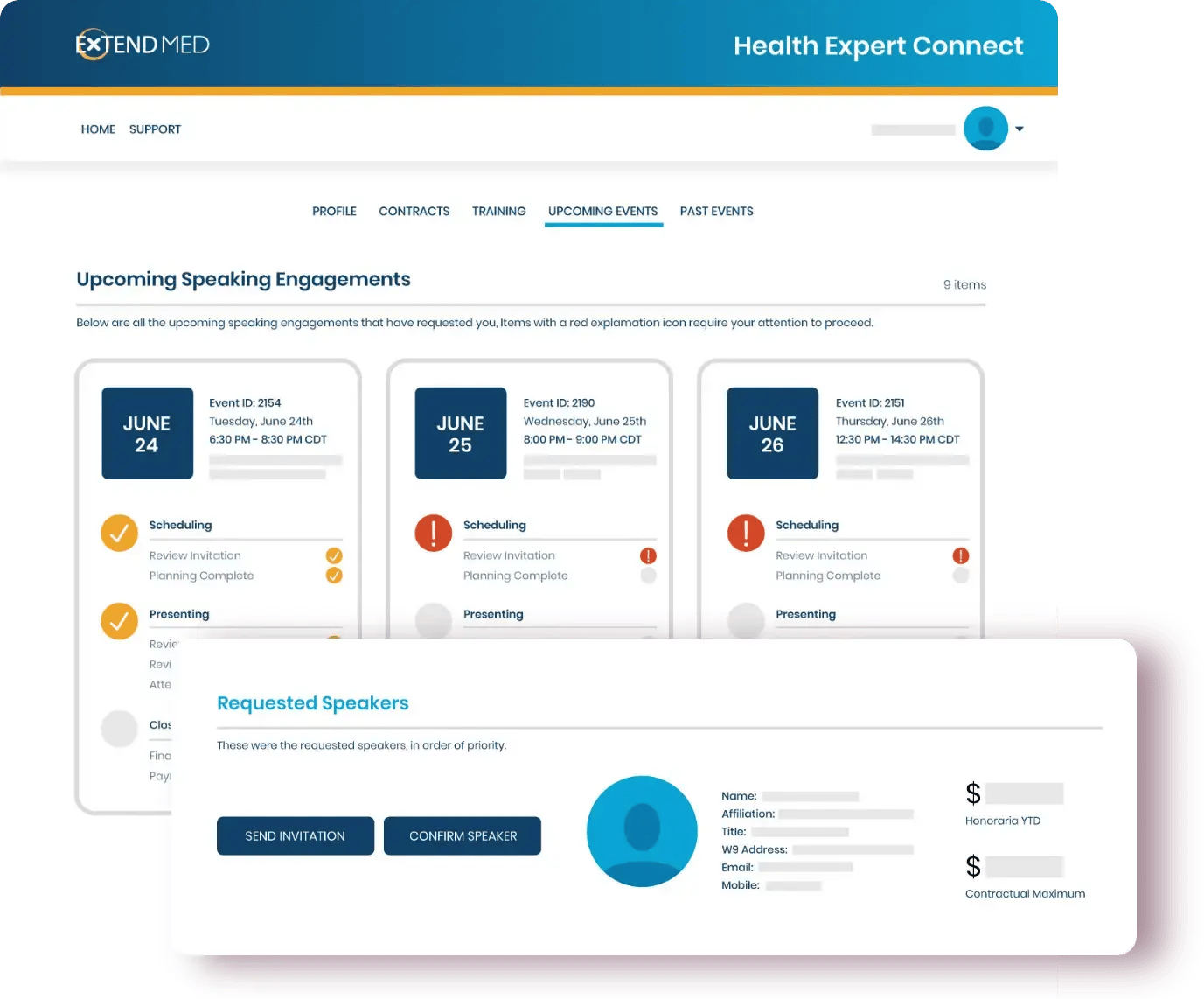
Here's a brief look at how we make one engagement modality — speaker programs — much more effective through proper tooling.
ExtendMed's platform, Health Expert Connect, allows you to easily manage all the steps necessary for hosting a successful speaker program. Today, we will walk you through how we can support your events from multiple user perspectives, a representative, speaker, project manager, and attendee. Before we get started, I want to show you how the system is set up. Just a quick overview. From a setup perspective, we can brand the platform with your company's logo, program information, and branding for your product. We can set styles in terms of colors, add to the footer with your privacy policy copyright information, et cetera. Now let's go ahead and start as a representative. You can see I'm logged in here as Representative Carol Bailey, and I'd like to go ahead and add a new event. I have the ability to name my event. I'll just name this test event. 65, and it's going to be in Baton Rouge, where I live, and this is my territory. I'm going to choose from a topic. This topic corresponds to a slide deck, and I'm going to go ahead and make this event, schedule this event for a couple weeks out on February 20th, I'm going to start the event at 6 p. m. And I know that Tuesdays are a good day for my target HCPs, and I'm going to end the event two hours later at 8 p. m. So from here I'm going to make this event an onsite events. I'd like to have the speaker. Join us at a restaurant I'm estimating that there will be 8 attendees and I'd like to do this at men's tours on the boulevard in Baton Rouge. So all the address information is already stored and I can move on in this process. My next step is going to be to select a speaker. Here on this page, I can see the speakers who are eligible to speak on this particular deck, and I can go ahead and select from these options. Speaker Elizabeth Heiden is very close from a travel perspective. She is only two miles away from my restaurant venue. And in addition, she has high ratings. So I'm going to go ahead and choose Dr. Heiden for my speaking event. What I'd now like to do is to log in as a project manager just to give you an overview of the approval process. So while the representatives are able to, as we just demonstrated request a new event, request a speaker, request a venue select whether they're conducting a webcast event or an on site event, etc. The project managers are getting notified so that they can go through the approval process for all the events that are requested. So going back into the system now as a project manager, you can see in the top right corner here, I'm going to go ahead on my management tab and look at all the events that are needing approvals as this page comes up, you'll see that there are some events that that are already live. There are some events that are overdue, etc. So I can track the status of my events. I'd like to go in and show you what an event looks like. What approvals are needed for each event. So let's go through this particular event, which is coming up on February 6th and see what the approval status is. It looks like all the planning has been done, and this event has already moved to live status so that the representative can start recruiting. The speaker has confirmed availability and gotten an email to do so. We have turned on accounting, we have added any planning expenses, and so that you can see the venue details we can go to the specific venue information, and if I have any updates I need to make, I could add them here. There is an email associated with the event planner at the restaurant. The, name of the restaurant contact is stored, the phone number, etc. If I want to add any AV requirements, I can do so here. So all the venue details are already stored here, and I have that carried over because I've planned events previously at Mansurs. In terms of speaker, I can see that the speaker has also been approved. So, this event gives you an example. It is now ready for the representative to start recruiting. Going to go back in now as a representative, go to my test event 63 and start to invite some of my target HCPs to this event. So, here is event 63 to go to my event details. Go to my management page, and I can see that 5 people have been invited to date. 3 have registered and since the event hasn't occurred yet, no one has attended. If I want to go into this event and see all the people in my territory, I can see I have 109 targets in my territory, and I can show all those targets at once. But that's a lot of people to go through, so I think I want to filter this list a little more thoughtfully. I'm going to select all the people, and I've already done this, all the people who are a certain distance from the, the venue. So. If I want to start out, I'll uncheck this for a moment and we can check miles from from where they, their personal address is. So let's go ahead. We, we will wait for this to come up. I have this set currently to 25 miles radius from the, from the restaurant venue. And here we have a listing of people who are this distance, 25 miles or less from the venue. You can see that I can then also search by last name, sort this by last name and go through here. Let's go ahead and sort. By last name with this list and now we can go ahead and start to invite people. If I talk to for example Dr. Kuhlman and Dr. Kuhlman says, yes, I'd like to register, then great. I can click register. If I want to invite Dr. Littel and send an email invitation, I can click invite and Dr. Littel will receive an email invitation. Now I also have the option to print invitations and I can do that at the top of my page. So here is an invitation printout that includes a QR code so that the doctors can easily scan the QR code and register for the event. All of that takes place on my event management page and I have the ability to recruit from my list target list of 191 HCPs. I'd now like to go to this event as a speaker. So you can see that I'm logged in here as Dr. Heiden. I'm going to go under my activities and events. Again, I'm looking for event 63, so here is my event 63. And I have the ability on this page to be able to mark myself as being interested in attending, first of all. And then I also have the ability to download any slide decks that are associated with this event. So there are my slide decks. Just to give you an example of other materials that can be shared here. We can look at a, an older event from. Earlier in the year and see other details that are stored. For example, I believe this event from October 19th. I can see my audience is going to be community endocrinologists. I can download the deck and since this event has already ended, I can submit expenses. Typically expenses are only eligible to be submitted within a window of several days, so whether your policy is 72 hours or 5 business days, et cetera, we can build that into the system and send reminders to the speakers so that they submit their expenses on time, including receipts. I'd now like to show you what what this looks like to be able to register for an event from a healthcare provider's perspective. So let's go ahead and look at one of these events. This is an event coming up. I'm going to go in just for a moment here as the project manager to copy the link. That is associated with that QR code, and we are going to enter it just to see what this looks like from a health care providers perspective. So, they come to this page, there can be details about the event, maybe an image associated with the event, and then they can register entering all their information. Again, this page can be branded. This can be templatized so that every event has a specific slide deck and certain speakers can be included here. Here we link to the speaker bio and so there's other information available for the event. I'd now like to just mention that we also allow after the event in closeout, we can go to a specific event as a project manager. And when an event is ready for close out, let's choose an event that has happened in the past. We'll go to this particular event, 1470. And when in the closeout process, a thank you note goes out to all attendees. For having attended the event in addition, they have the opportunity via a QR code to schedule a follow up meeting with the sales representative. So what that looks like from a user scheduling perspective, we'll go into my user scheduler, just so you can see .They would get a link if they were scheduling a meeting with me to have an introductory meeting and that link shows my calendars real time availability so they can schedule a meeting directly with the sales representative at their convenience. This is a really nice feature and many of our sales representatives report positive results from this. So in that thank you note, they have a QR code to book time with the sales representative. They can complete an evaluation and they get a reminder to complete the evaluation if they have not done so within a two day period. Going back to close out, we'll go to a specific event to close out here. Again, let's go to this particular event. We can go through the approval steps. The event has already happened. So we need to confirm that the speaker spoke at this event. And the speaker gets an email, an automated email, once the event's time has expired. In other words, we've gone past the scheduled event time they get a notice saying, please confirm that you spoke at the event. In this case, I'm going to as the project manager, complete those details on behalf of the speaker. And there's an audit trail that I have done so, so here I'm taken to the event page and I can go to management and I can mark the appropriate people as having attended. So the speaker is Heiden. I'm going to go ahead and select Heiden here. And mark Speaker Heiden as having attended so she has attended the event. We need to enter the time. It was a 60 minute meeting. And so those details are stored and I can go back through the approval process. So I can now confirm the speaker. I can confirm the 7 attendees again with an audit trail, and if there are any speaker expenses, I can go to accounting and make sure to include those details. So we do have an honoraria here for Speaker Heiden because she's contracted for $500 for a local event. There is also a $250 expense associated with the private room rental and then a $1,000 group expense for food and beverage. So all of that is captured here. The total event cost with these expenses is $1,750 and that does get generated on a Sunshine report. Hopefully this gives you a quick overview of our system. If you do have any further questions, we would be glad to address them in a live demonstration. But this video gives you an overview of our system and how you could use it to support your speaker programs.
What Fragmented Engagement Tools Actually Cost
The costs are very real, but they're quiet — the kind that don't show up as a line item, so they're easy to ignore until they compound and make themselves known when it’s a serious problem:
You can't see across your own engagements
This is the problem I hear most often now from teams coming to us to talk about a better system, and it's worth quoting the way a client actually put it to me.
When you run a siloed advisory board on one tool and a survey on another, you end up unable to connect them. You don't know how the data from your survey relates to the data from your advisory board, because they're two siloed analyses. You can't look at the big picture, which is where so much insight is waiting to be uncovered.
It gets worse at the organizational level. If you're responsible for the survey but a colleague runs the discussion forum, nobody at the company can say how many times you've reached out to a given HCP or patient over the past, say, two months. The engagement history is scattered across tools and departments, so the knowledge stays siloed at the department level, and the buck stops there. So many teams stuck in this situation are essentially flying blind on their most important relationships.
Compliance gaps open at handoffs
Every manual transition between the tools you use to engage HCPs (and other stakeholders) is a place where something can be missed.
For example:
- FMV documentation that lives in a contract system but not the spend tracker.
- Training status that's current in one tool but not verified before a speaker is confirmed in another.
- Sunshine-reportable transfers of value that have to be reconciled by hand from three sources after the engagement closes.
When payment tracking, contracting and engagement all live in separate systems, the audit trail is only as complete as the last manual reconciliation somebody remembered to do. When it lives in one system, the trail is complete by default.
Your team spends its time on logistics instead of strategy
This is the cost that frustrates me most, because it's in a way the most wasteful.
Your smartest people (the ones who should be designing better engagement questions and synthesizing what advisors are telling you) are instead consolidating spreadsheets and chasing signatures across tools.
One agency we work with described the situation before they consolidated: their operations manager was spending more time managing the tools than managing the programs. That's a direct quote and it's the clearest description of the problem I've heard. When the tools become the job, the actual work suffers.
What one platform replaces
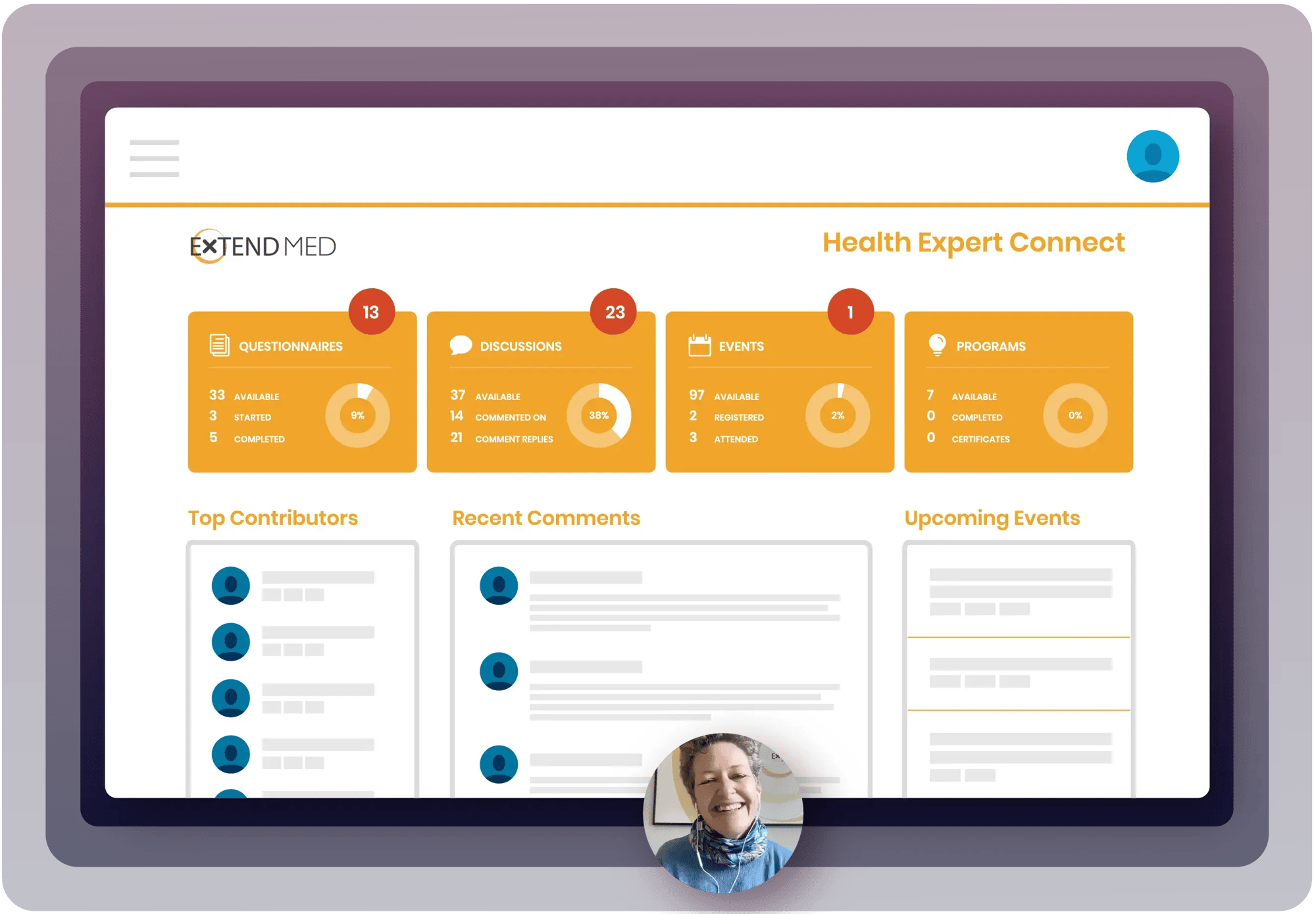
Our platform, Health Expert Connect™, runs the full engagement lifecycle in a single system.
Virtual meetings, surveys, threaded discussion boards, contracting, resource centers, honoraria and FMV tracking, Sunshine reporting and analytics. The seams disappear because there are no seams.
See how it works »
Why the Patchworks Persist
If fragmentation is this costly, why do so many teams still live with it? I’ve seen three reasons, and none of them are that teams don't see the problem. They definitely do.
- First, the tools were adopted one at a time to solve one problem each, and no single one feels broken. The video tool works fine. The survey tool works fine. The problem is only visible when you look at the whole, and most teams are too busy running programs to step back and look at the whole.
- Second, some of the tools in the stack aren't built for pharma. General-purpose video and survey tools don't come with NPI validation, FMV documentation or Sunshine-ready reporting because they were never designed for regulated healthcare engagement. Teams bolt compliance on around them because switching feels harder than coping.
- Third, switching feels like a big lift. Migrating off a legacy system, retraining a team and moving historical data sounds like a project nobody has time for. In practice, the teams that make the move usually find the lift smaller than they feared and the relief immediate, but the perceived cost keeps a lot of teams stuck. The work here always pays dividends.
What Consolidation Looks Like in Practice
Replacing your legacy stack with one platform is all about running every engagement type through the same system so the data, the compliance and the advisor experience are consistent across all of them.
The range matters here because the whole point is that one platform covers what previously took many.
On a single system, a team can run live, virtual and hybrid advisory boards, peer-to-peer speaker programs, congress engagement, steering committees, publication planning and manuscript collaboration, MSL and rep engagement, market research and pricing focus groups and video, webcast and podcast programs. That consolidation produces benefits a stack structurally can't.
Here’s what life looks like on the other side of consolidation:
One consistent experience for advisors and HCPs
When every engagement runs through the same platform, the people you're engaging get familiar with it fast.
Whether you're reaching out to a clinician for an advisory board or a patient for a survey, they see the same interface, the same branding, the same sender. That familiarity does real work. When we run engagements across wildly diverse audiences on a consistent platform, we rarely need to work on technical support. The barrier of "now log into this other tool for this other thing" disappears.
One dataset you can actually analyze
When every engagement runs through the same platform, the people you're engaging get familiar with it fast.
Whether you're reaching out to a clinician for an advisory board or a patient for a survey, they see the same interface, the same branding, the same sender. That familiarity does real work. When we run engagements across wildly diverse audiences on a consistent platform, we rarely need to work on technical support. The barrier of "now log into this other tool for this other thing" disappears.
One compliance layer
FMV rates, NPI validation, honoraria caps, transfer-of-value tracking and Sunshine-ready exports all live in the same place as the engagement itself. There's no separate reconciliation step because the documentation is generated as the work happens.
The audit trail is whole because nothing had to be stitched together.
Real economies of scale
Consolidation is much more cost-effective than maintaining parallel tools and the manual labor to run between them. And because the operational overhead drops, teams can engage more frequently across more modalities on the same budget.
This is how smaller and mid-size companies punch above their weight. A smaller team can reach stakeholders anywhere, run multiple engagement types and get the same results a much larger organization would, sometimes faster, because they're not burning resources on logistics.
A consolidation story, from a team we helped live it.
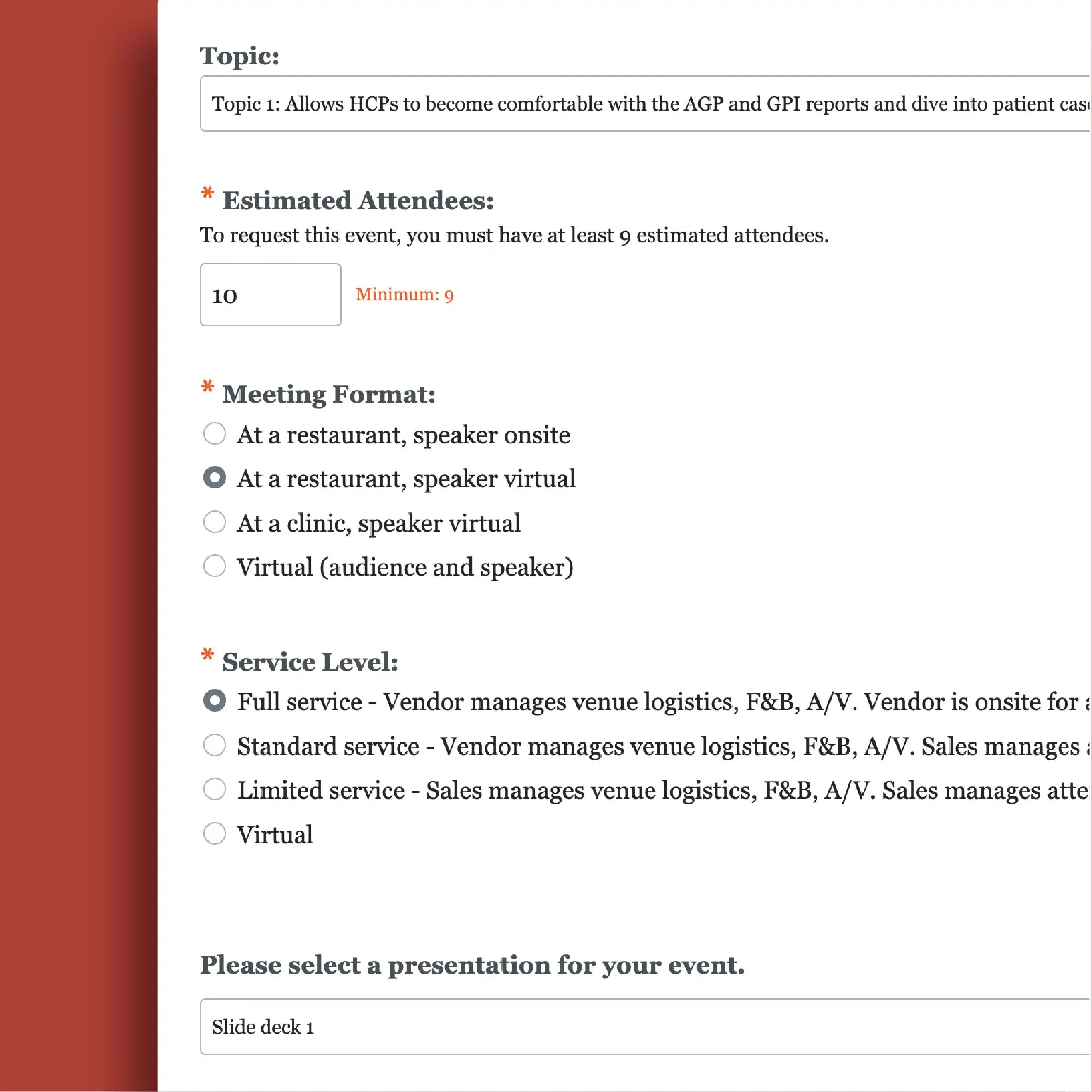
One agency partner came to us running one tool for speaker, venue and travel logistics, another for registration and separate applications for evaluations, email and data analysis.
After moving everything onto Health Expert Connect™, their data tracking got dramatically stronger and they scaled into a speaker bureau powerhouse without adding headcount.
As their director put it: "What really stood out about ExtendMed was its ability to bring everything into a single, streamlined platform."
Read our case studies »
How to Tell if You’re Ready to Consolidate
A lot of teams overthink this. No need — there are a few signs that your stack has become the problem:
Your team spends more time moving data between tools than analyzing it.
- You can't answer a simple question like how many times you've engaged a given HCP this year without pulling from multiple systems.
- Your compliance documentation requires a manual reconciliation every time an engagement closes.
- Some of the tools you rely on weren't built for pharma and you've bolted compliance on around them.
- You're passing on engagement opportunities because your current setup can't handle the added complexity.
If one (or especially several) of those are true, the stack might be holding you back more than it’s enabling you to do great work.

See What One Platform Looks Like for You
The teams pulling ahead aren’t getting there by adding more engagement tools. They replaced the patchwork with a single platform, got their compliance trail whole by default and freed their people to focus on strategic work instead of working on the work.
If your team is running HCP engagement across a patchwork of tools and you're ready to see the alternative, let's talk. We'll walk you through Health Expert Connect™, show you how teams consolidate onto one system and help you figure out whether a licensed or fully managed model fits your operation.
Request a demo of Health Expert Connect™ →
No pressure. No spam. Just a practical conversation about what your engagement strategy could look like without the seams.