

At a glance
The speaker bureau programs pulling ahead today are consolidating scattered tools into a single platform.
They're automating compliance so it enforces itself, putting guided workflows directly in reps’ hands, encoding SOPs into the system instead of a binder, turning reporting into a real-time decision-making tool, giving speakers self-service hubs and choosing technology partners over technology vendors.
Every practice in this post is drawn from what we’re seeing work right now with our clients and agency partners—including one agency managing 700+ programs a year on our Health Expert Connect™ platform without scaling headcount.
Get an overview of our speaker program capabilities here:
If you're managing speaker programs in 2026 (and likely planning for 2027), you already know that the space has changed quite a bit recently. Speaker programs have become even more complex than they were even five years ago.
- The volume of programs is up.
- Compliance requirements are tighter.
- Hybrid and virtual formats have become permanent fixtures alongside live dinners and presentations.
- The expectation from both internal stakeholders and external HCPs is that these programs run seamlessly, with full transparency and measurable impact.
However, too many teams are still stitching it all together with spreadsheets, email threads, calendar invites, and manual oversight. That patchwork approach worked when you were running a few dozen programs a year. It doesn't work when you're running hundreds, and it becomes genuinely dangerous from a compliance standpoint when you're managing millions in aggregate HCP spend.
As CEO of ExtendMed, I've spent the last 20-plus years working alongside pharma teams and their agency partners to solve this exact problem. In that time, I've watched the requirements evolve from simple logistics coordination to something far more comprehensive.
Below is a practical, detailed breakdown of the capabilities you should demand from any speaker bureau platform you evaluate in 2026 and going into 2027, alongside some candid perspectives on what separates platforms that check boxes from platforms that actually transform how you work.
Health Expert Connect™ for end-to-end speaker program management
Pharma teams running speaker programs can dramatically improve productivity with a technology platform purpose-built for outreach, live and on-demand engagements, contracting, Sunshine reporting and other administrative tasks—all in one place.
As more teams adopt these platforms, HCPs increasingly expect the convenience they provide. Without the right tool, managing a modern engagement program can become burdensome, time-consuming and less effective, giving you insights with lower fidelity and business value.
ExtendMed helps teams plan and execute speaker programs while maximizing KOL interactions at a fraction of the cost of a typical management workflow.
Teams can choose full-service management, with us handling every aspect of execution, or a self-directed model where internal teams operate the platform independently. The self-directed option is ideal for large-scale speaker programs of 200+ events, offering a cost-effective way to use our speaker program technology while maintaining direct control, compliance and tracking.
Use the arrows on the platform overview below to flip through a few of Health Expert Connect's speaker program capabilities.

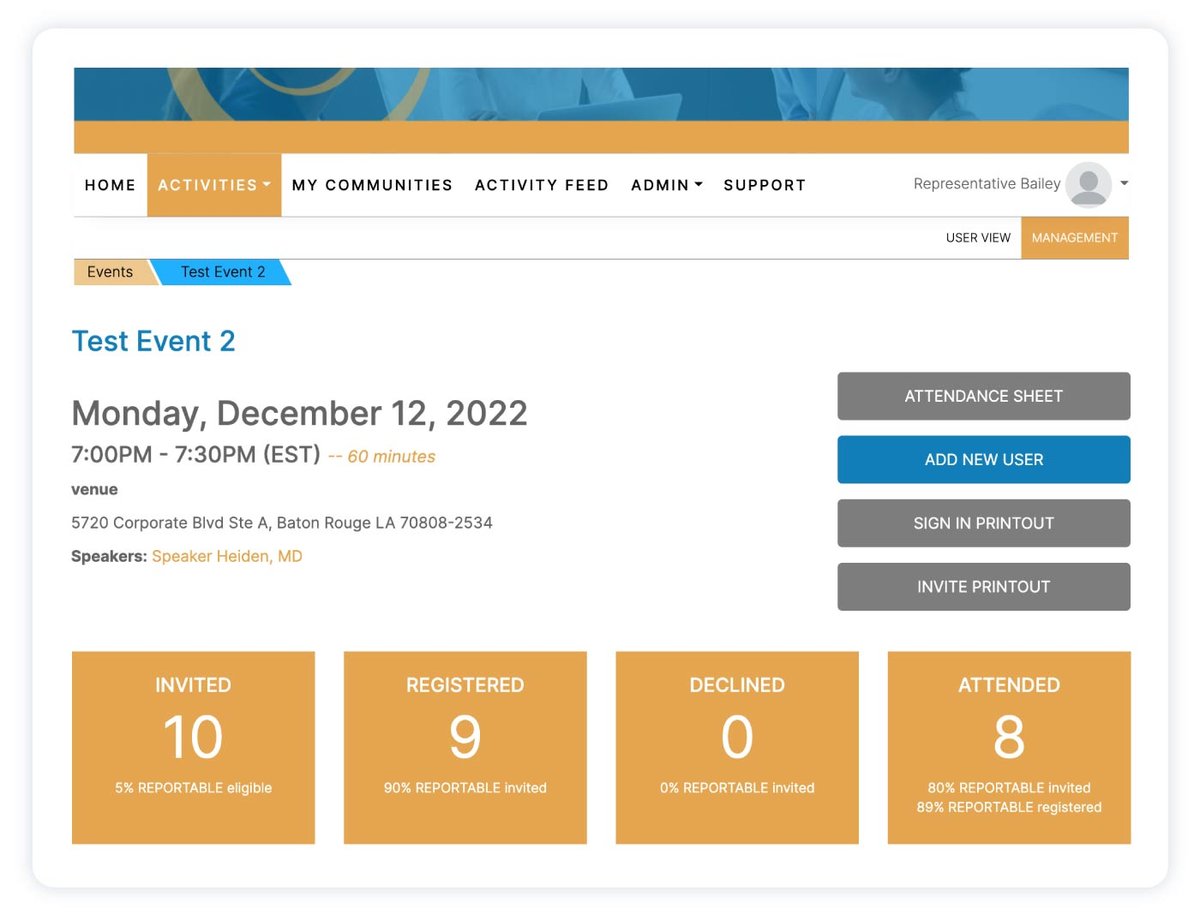
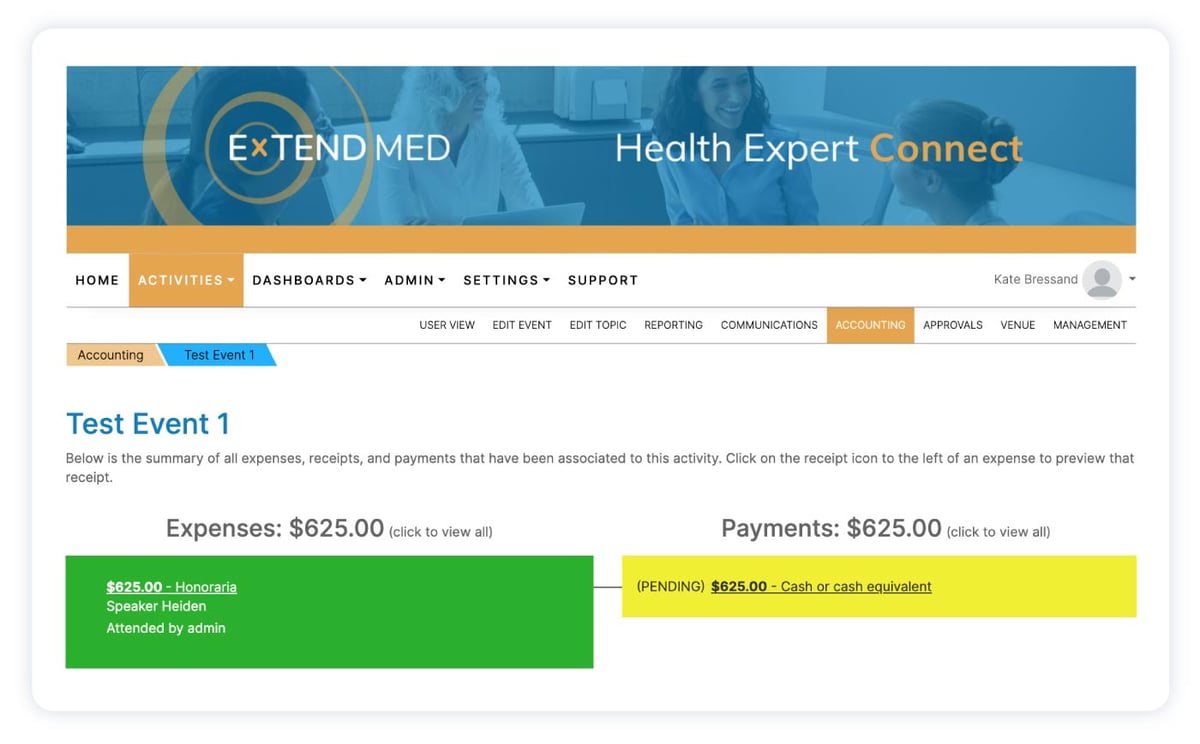


1. End-to-end lifecycle management in a single platform
Speaker programs are obviously not a single activity. They're a multi-stage lifecycle: contracting, speaker training, field requests, logistics coordination, event execution, attendee management, expense reconciliation, payment processing, and post-event reporting.
When each of those stages lives in a different tool (or worse, in someone's inbox), the risk of errors compounds at every handoff. Data gets duplicated, steps get skipped, and nobody has a clear picture of the full program.
The first thing to look for in a platform is whether it genuinely manages the entire lifecycle from speaker onboarding to final Sunshine report, or whether it only handles a portion and expects you to fill the gaps manually. Many platforms excel at one slice (virtual meeting hosting, for example) but leave you to manage everything else on your own. That's not a speaker bureau platform. That's a meeting tool.
A true lifecycle platform should handle contracting (ideally with e-signature integration), speaker profile management, training and certification tracking, field rep program requests, venue and logistics coordination, attendee registration, live and virtual event execution, expense tracking and reconciliation, payment summarization, compliance reporting, and program analytics.
All connected, all in one place.
Health Expert Connect™ for total lifecycle management
ExtendMed’s platform was built specifically for this kind of end-to-end speaker program management. Every stage of the lifecycle flows through a single system.
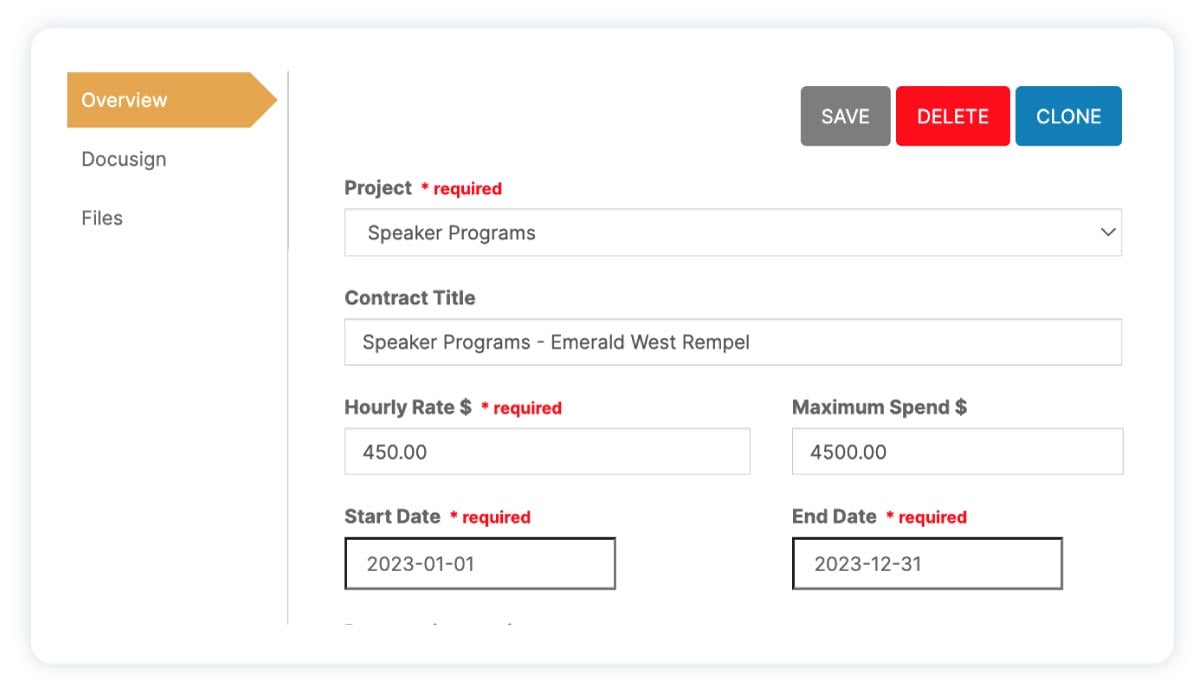
- Contracts are managed with a DocuSign integration.
- Speaker profiles store credentials, FMV rates, training status, and resume uploads in one place.
- Field reps request programs through a guided workflow.
- Logistics, registration, event execution, expense reconciliation, and Sunshine reporting all happen within the same platform, so there's never a gap where data has to be re-entered or manually transferred between systems.
2. Guided field rep request workflows
In most speaker programs, the field sales representative is the one initiating a program request. They need to select a topic, choose a date and time, identify a venue, and request a speaker, all within compliance guardrails they may not fully understand.
If that request process is unstructured or happens over email, the corporate team ends up spending enormous amounts of time—we’ve seen teams spend upwards of 40 hours— chasing missing information, correcting errors, and manually checking whether the request even meets policy requirements.
A strong platform should provide a structured, guided request process that walks the rep through each step, enforces business rules automatically, and captures all necessary information before the request hits the program manager's desk. It should feel intuitive enough that a rep in the field can complete it in minutes, but robust enough that it eliminates the back-and-forth that slows everything down.
Look specifically for these capabilities within the request workflow:
- Automatic enforcement of lead-time requirements and local time-zone logic
- Integration with mapping tools for venue selection (so reps take accountability for selecting and confirming their venue)
- Auto-filtering of eligible speakers based on proximity, certification status, and contractual availability
- Automatic budget generation the moment a request is submitted.
All the tools and workflows reps need, in one place
We've built a four-step guided request process that reps can complete in minutes.
- Choose a certified slide deck and meeting format.
- Select a date using a picker that enforces lead time and local time zone.
- Search Google Maps to select a venue and capture food, beverage, and AV needs in one step.
- Review an auto-filtered speaker list that shows distance from the venue, eligibility, and availability, so the rep can choose from a pre-qualified list rather than guessing.
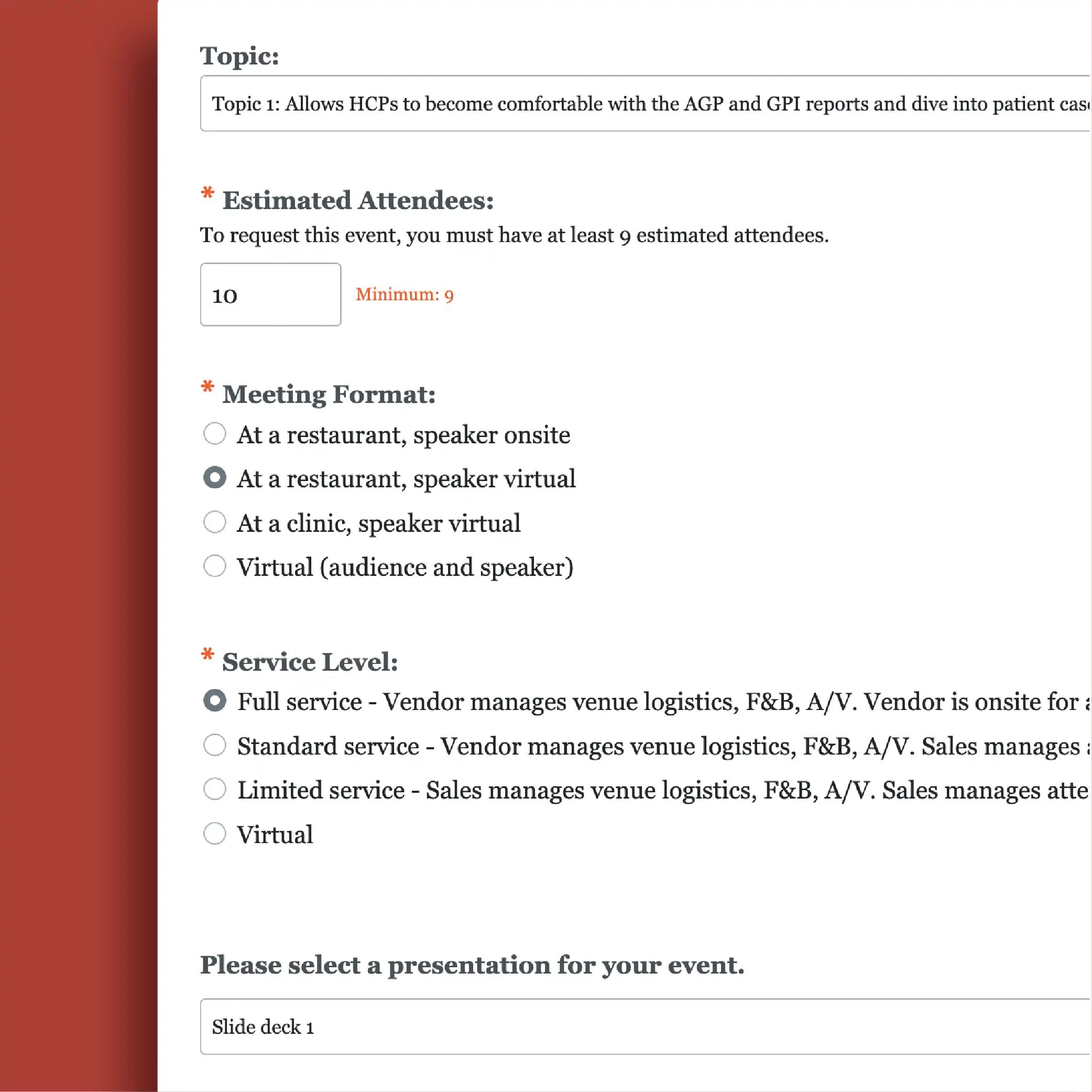
As soon as the request is submitted, the platform auto-generates a budget based on the selections and pushes the request into the approval workflow.
One of our clients told us that the rep request process was one of the most transformative features they implemented, turning a previously email‑ and spreadsheet‑heavy workflow into a centralized, automated intake that dramatically reduced manual effort and improved visibility across their programs.
3. Automated compliance, FMV tracking, and Sunshine readiness
Compliance is obviously not optional in speaker bureau management, and a major operational pain point for pharma teams with ad hoc systems for it.
- Every dollar paid to an HCP, every meal served at a dinner program, every honorarium and travel reimbursement must be tracked, categorized and reportable under the Sunshine Act.
- Fair Market Value (FMV) rates must be enforced consistently.
- NPI numbers must be validated for every attendee and speaker.
And all of this must be auditable at any time.
When compliance tracking is manual (scattered across spreadsheets with receipt uploads in email threads and payment summaries compiled quarterly), the risk of errors, omissions and audit exposure is huge.
A single missed transfer-of-value report or an overpayment against a speaker's FMV cap can trigger internal company or external regulatory scrutiny that dwarfs whatever you saved by not investing in proper tooling that would have prevented it.
The platform you choose should:
- Automate FMV tracking against contractual caps.
- Validate NPI numbers for both speakers and attendees.
- Maintain full audit trails for every program action.
- Automatically categorize expenses (honoraria, travel, venue, meals).
- Support Sunshine-ready export of transfer-of-value data in formats compatible with your CMS reporting pipeline.
- Provide near real-time spend monitoring with budget alerts so you can catch issues before they become problems.
The platforms that handle this well don't just track spend after the fact. They enforce your specific program rules at the moment a decision gets made, before a problem can happen. That's the difference between a system that records compliance and a system that produces it.
In practice, that means the platform should let you set and automatically enforce rules like:
- Speaker utilization caps, so a speaker who has already delivered your maximum number of programs (say 20) can't be booked again.
- FMV spend caps, so a speaker approaching their annual contractual maximum is flagged before the engagement is confirmed.
- Training requirements, so only speakers certified on the specific presentation can be selected for it.
- Minimum attendee thresholds, so a program can't proceed without enough registrants to justify it.
- Per-head meal limits, applied at the approval stage so spend stays inside policy.
- Venue rules, so reps stay inside your guidelines on what kinds of venues are acceptable.
These are the speaker-program risk factors that trip teams up in an audit, and they're exactly the rules a manual process can't reliably enforce.
Compliance is woven directly into every process
In Health Expert Connect™, compliance is actually built into the architecture of our platform, not bolted on as an afterthought.
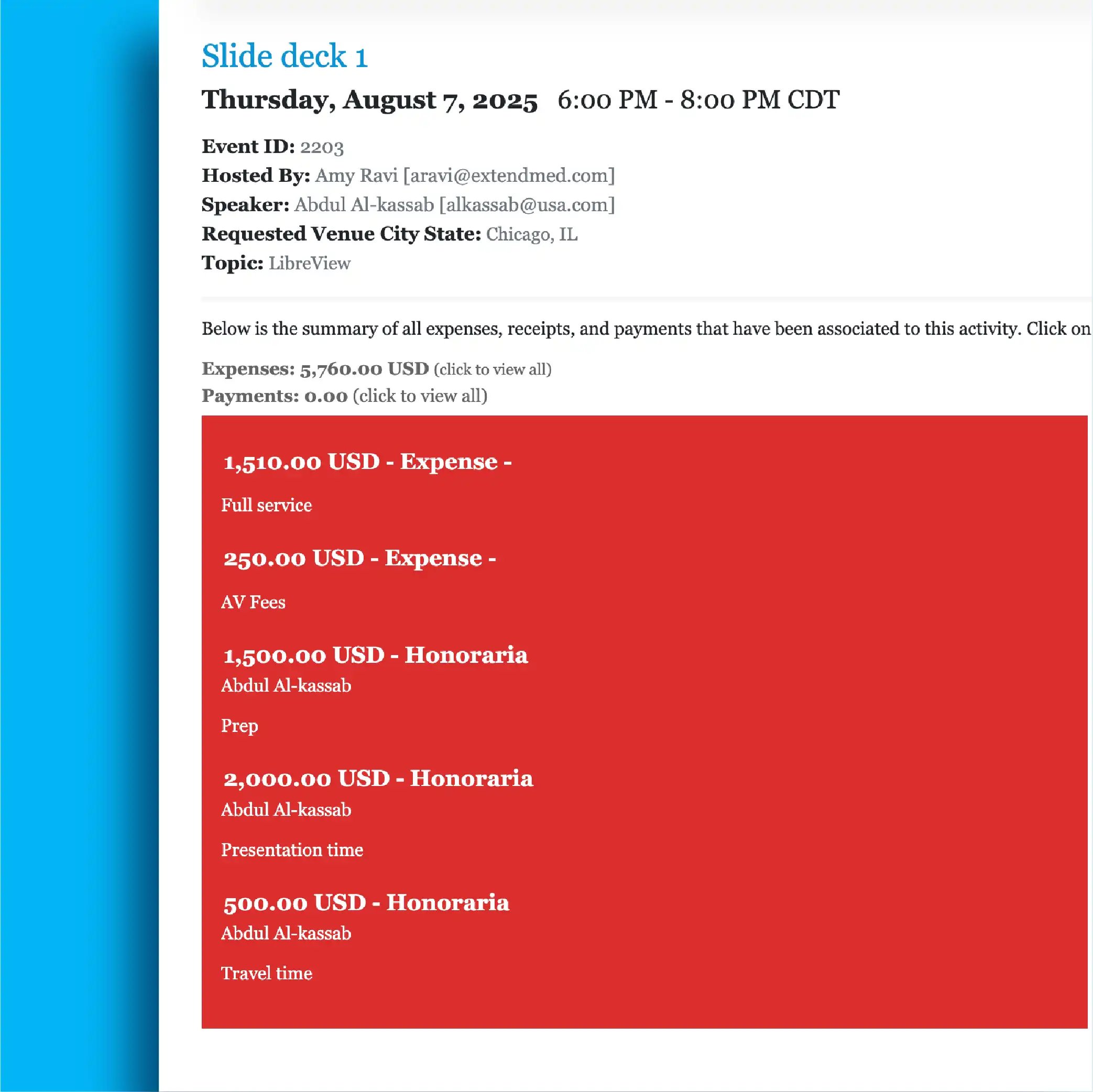
Here's a breakdown of just some of Health Expert Connect™'s compliance tooling:
-
MV rates are stored in each speaker's profile and enforced automatically. Program managers can see a speaker's year-to-date spend and contractual maximum before confirming any engagement.
-
We also enforce your rules at the point of decision. When a rep builds a request, the speaker list is auto-filtered. Speakers who've hit their event cap, exceeded their spend maximum, aren't trained on the chosen deck or aren't contracted simply don't appear as eligible. Programs can't be submitted below your minimum attendee count.
-
Meal limits and venue rules are codified into the approval workflow, so a manager reviewing a request sees the policy applied, not just the request.
-
NPI validation runs at registration for attendees, and speaker profiles capture NPI, taxonomy codes, license information and W9 data alongside Sunshine Open Payments requirements.
-
Every expense is categorized at creation (speaker honoraria, speaker travel, venue costs, group meal costs, management fees) and flows through to compliance-ready exports.
-
We track everything, not only for the speakers and their expenses, but also for the people who received the benefit of a meal. For every attendee we have their NPI, and we can associate and report that transfer of value to the government.
A no-code business rules editor is what makes this work. You define your organization's policies once, like lead-time requirements, budget thresholds, approval routing and utilization caps, and the platform applies them to every program automatically.
4. Customizable workflow approvals that become your SOP
Every company runs speaker programs a little differently.
Your approval routing, your internal review steps and your closeout procedures are all shaped by your compliance policies, the way you’re structured and the lessons you've learned from past programs.
-
A platform that imposes rigid, one-size-fits-all workflows forces you to adapt your process to the technology instead of the other way around.
-
This is one of the common reasons teams move to our platform from others. It aligns with how you actually want to work rather than forcing a process on you.
What you need is a platform whose approval workflows are fully customizable. You should be able to define multi-phase approval sequences (planning, execution, attendance, expenses, payments, closeout), assign specific roles and team members to each step, set due dates and escalation rules, and track completion in real time.
Done right, these workflows become more than just project management. They become your actual living standard operating procedure: a built-in training tool that ensures consistency across every program manager, every rep, every region.
This matters especially when you're scaling! When you go from 50 programs a year to hundreds, the first thing to break is consistency. New staff don't know the process. Managers can't track status across dozens of simultaneous programs. Workflow approvals that are baked into the platform eliminate that fragility.
Workflow approval customization wherever you need it
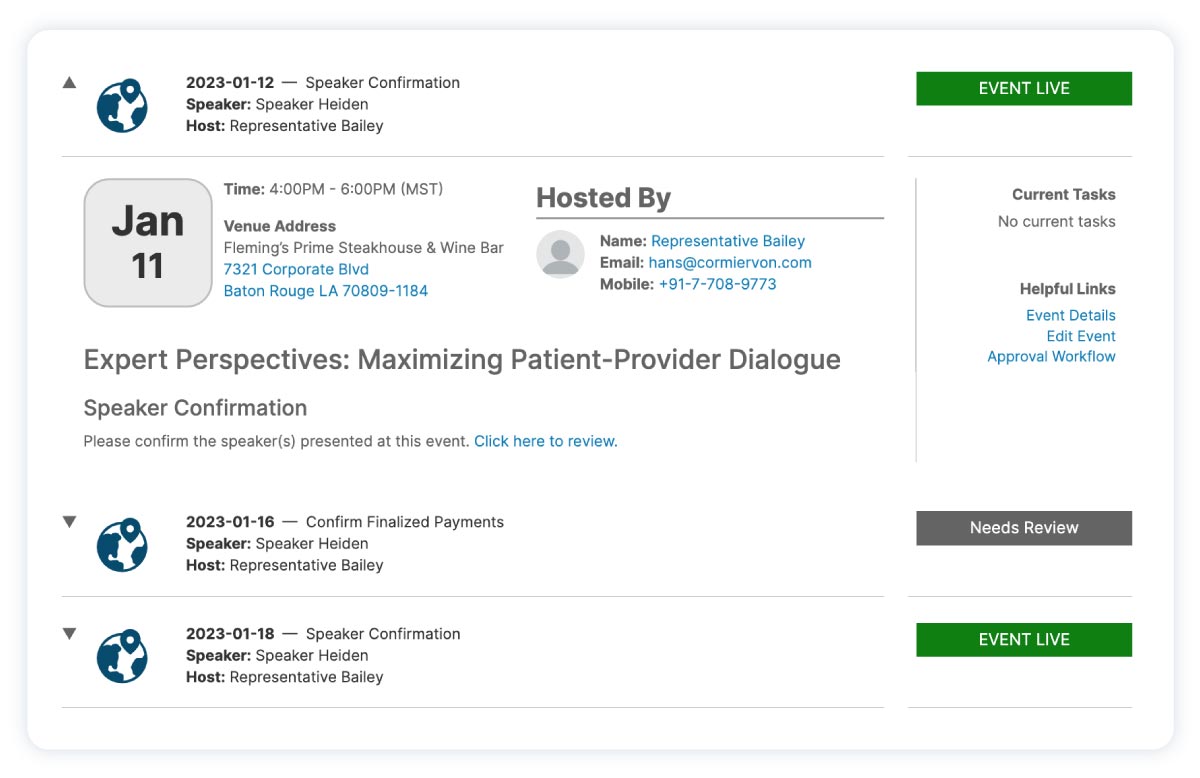
Our approval workflows are fully customizable to match your SOPs. Programs move through defined phases (planning, attendance, expenses, payments, closeout) with specific approval steps, assignees, and due dates at each stage.
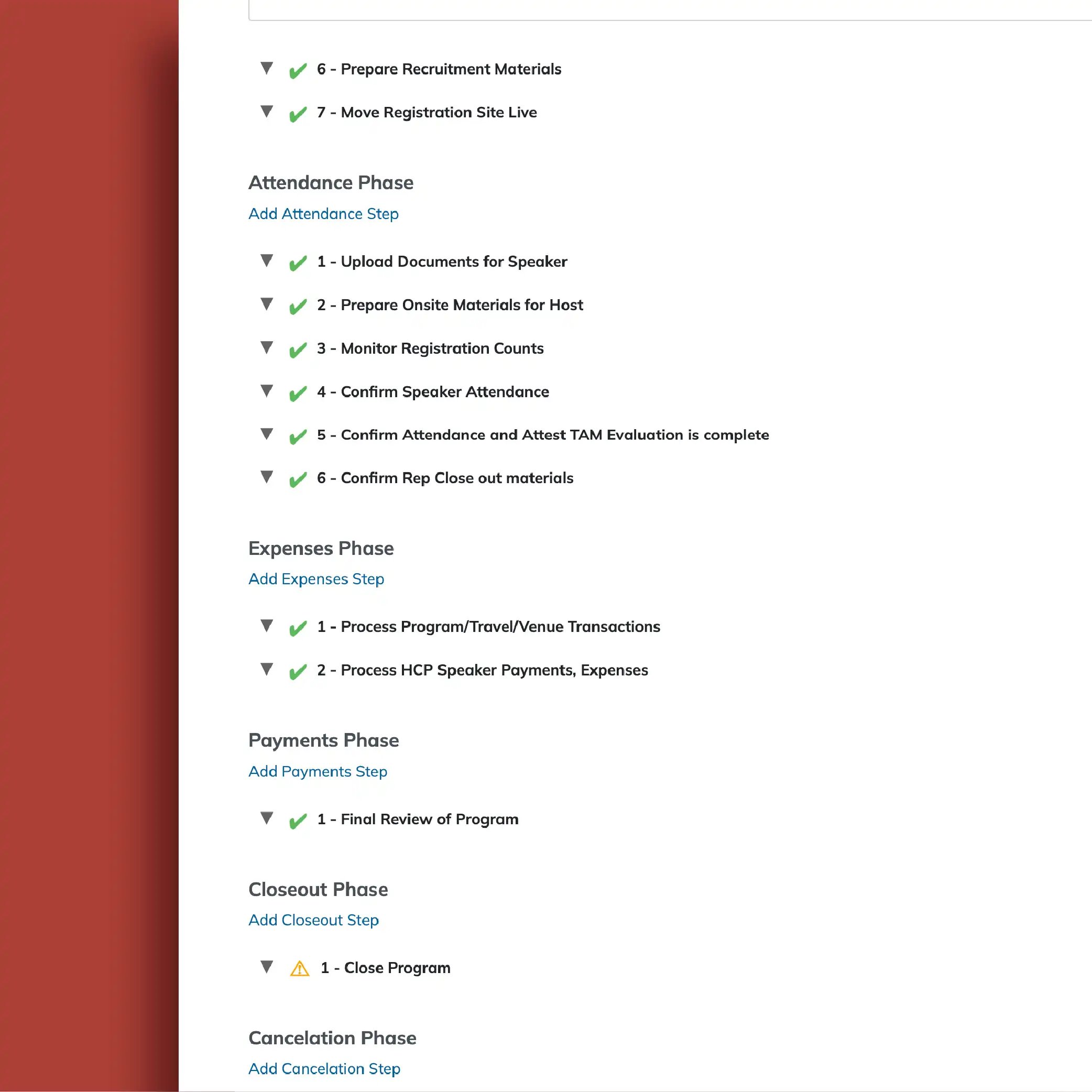
Managers see a checklist view that shows exactly where every program stands, what's been completed and what's outstanding.
5. A dedicated portal for speakers
Speakers are the heart of your program, yet they're often the most underserved stakeholders in terms of tooling and convenience.
Many speaker bureaus (even some of the largest) still communicate with their speakers primarily through email—sending contracts as attachments, providing training materials as PDFs, confirming engagements with calendar invites and collecting receipts via email reply. This is inefficient for your team, frustrating for your speakers, and creates compliance risk every time a document gets lost in someone's inbox.
A modern speaker platform should provide speakers with their own dedicated portal—a single place where they can:
-
View and sign contracts
-
Complete training and track certification status
-
See upcoming speaking engagements with all relevant details
-
Review presentation materials
-
Submit receipts and expenses
-
Manage/update their profile information
Speaker amenities like these aren't seen as some kind of "luxury" anymore. Once a speaker experiences a system that’s built for them, it’s tough to go back to ad hoc collaboration in the inbox. It's quickly becoming the minimum bar for respecting speakers' time and maintaining the relationship that makes your program work.
Put yourself in your speakers' shoes
Which company would you be more motivated to speak for: one that give you a convenient system like the one we just described, or one that forces you to work through endless emails and basic attachments?
The portal your speakers deserve (and many expect!)
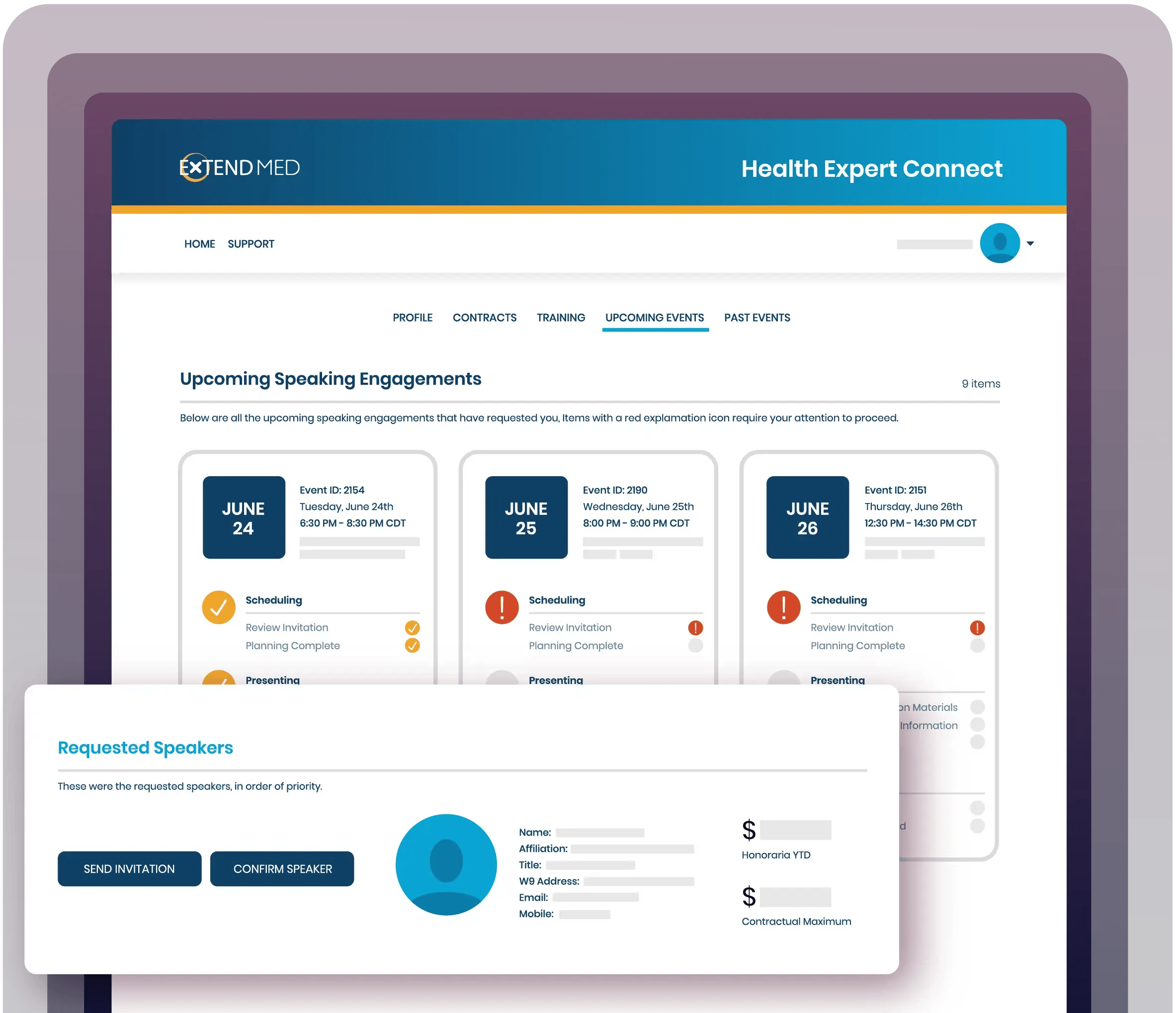
Every speaker in our system has access to a personal dashboard with tabs for their profile, contracts, training, upcoming events and past events. They can see all upcoming engagements and the tasks they need to complete for each one: reviewing invitations, confirming presentation materials, attending the event, and finalizing expenses.
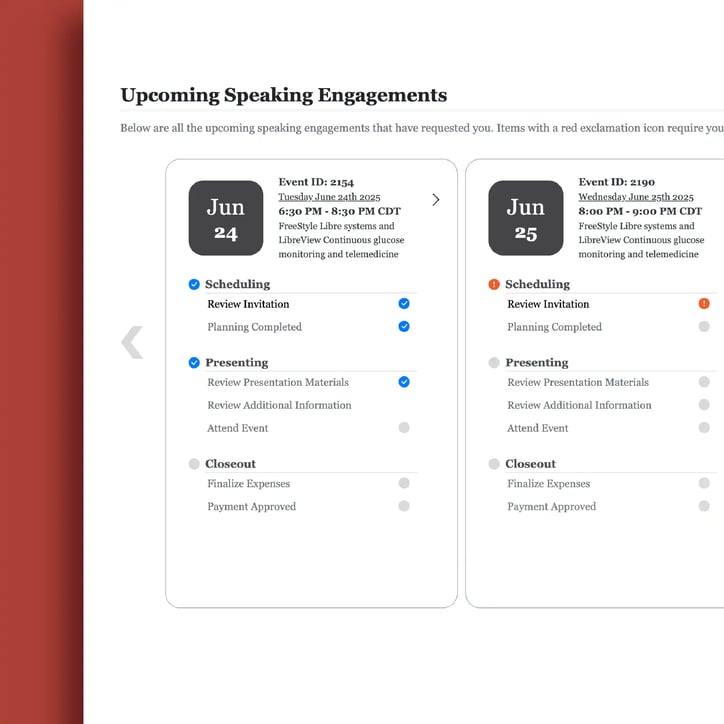
Training status is tracked at the deck level, so speakers and program managers both know exactly which certifications are current and which need renewal. Contract terms, hourly rates, and remaining annual caps are visible at a glance.
It's all in one place, and it eliminates the constant back-and-forth that drains both the speaker's time and your team's bandwidth.
6. Audience engagement and registration tools
The quality of a speaker program isn't measured only by whether the event happened on time. It's measured by:
- Who actually attended
- How engaged they were
- What they took away from it
Yet many programs still rely on manual registration tracking, like sign-in sheets at dinner events, email RSVPs for virtual programs and miss the opportunity to capture this real engagement data.
Look for a platform that provides:
- Branded registration microsites for each event (with NPI lookup built in)
- Automated confirmation emails with venue directions or webinar join links tailored to the event format
- In-meeting interactivity tools like polling, Q&A, and quizzes
- Automated post-event evaluation distribution
- Waitlist management for high-demand programs
These tools don't just make events run more smoothly. They generate the data you need to demonstrate program effectiveness. which HCPs are attending, how they're engaging and what they're learning.
Everything you need to engage your audience like it's 2026
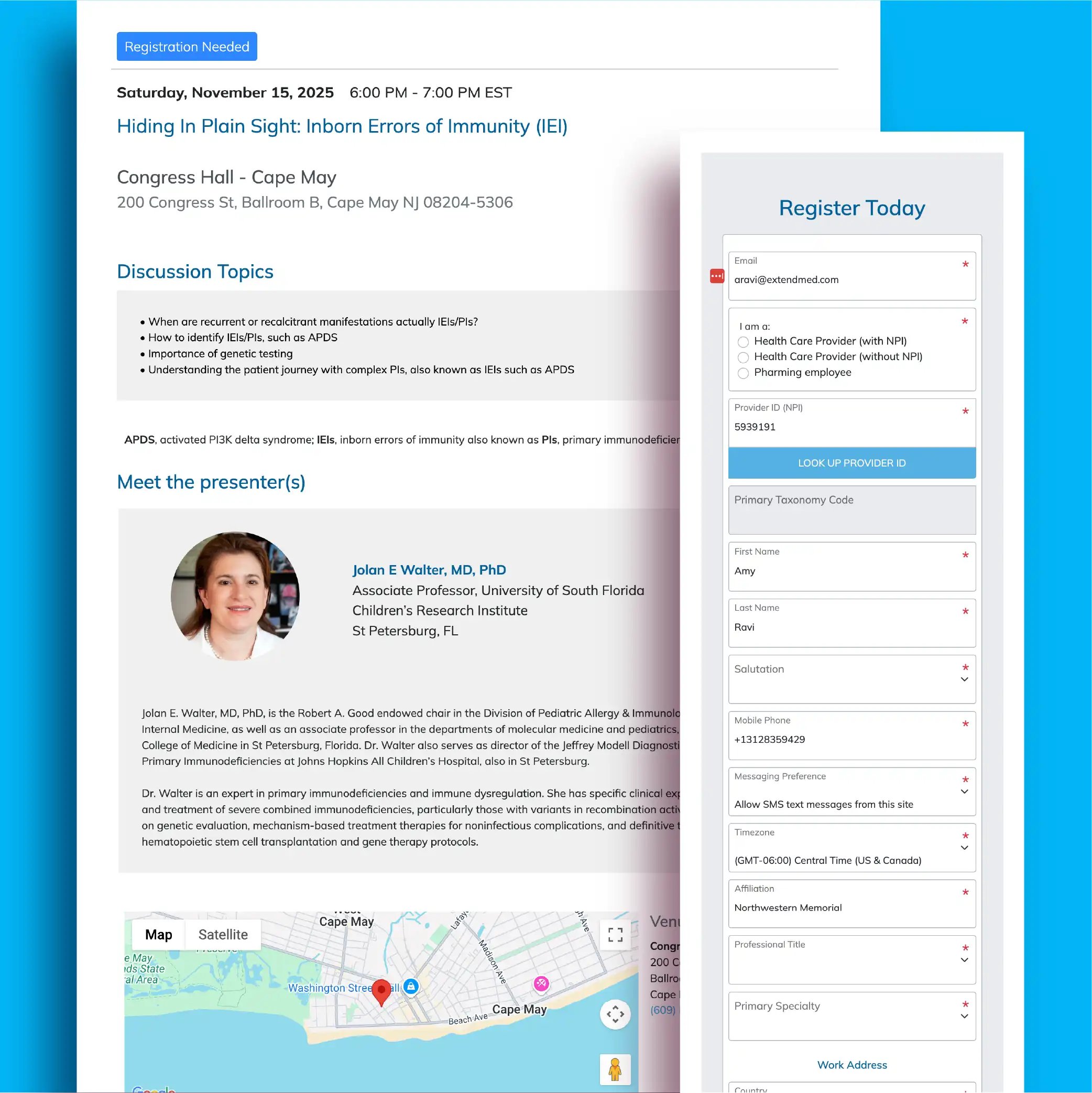
Each program on our platform has its own event microsite, with NPI lookup and venue mapping built into the registration page. Confirmation emails are generated automatically and tailored to the event format (hybrid confirmations, for example, include both venue directions and webinar join links).
PRC-approved email templates are stored in a library and deployed through the platform's automation engine, ensuring brand and regulatory consistency.
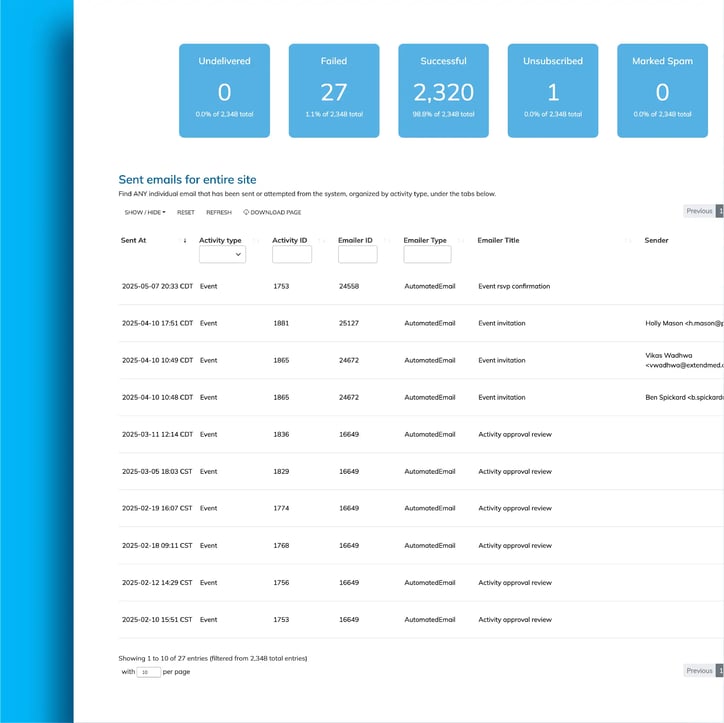
During events, we support interactive features including polls, Q&A, and quizzes. After events, automated thank-you emails go out with one-click evaluation links. Every email sent through the platform is tracked. You can see delivery status, opens, and bounces, and resend to specific recipients in seconds.
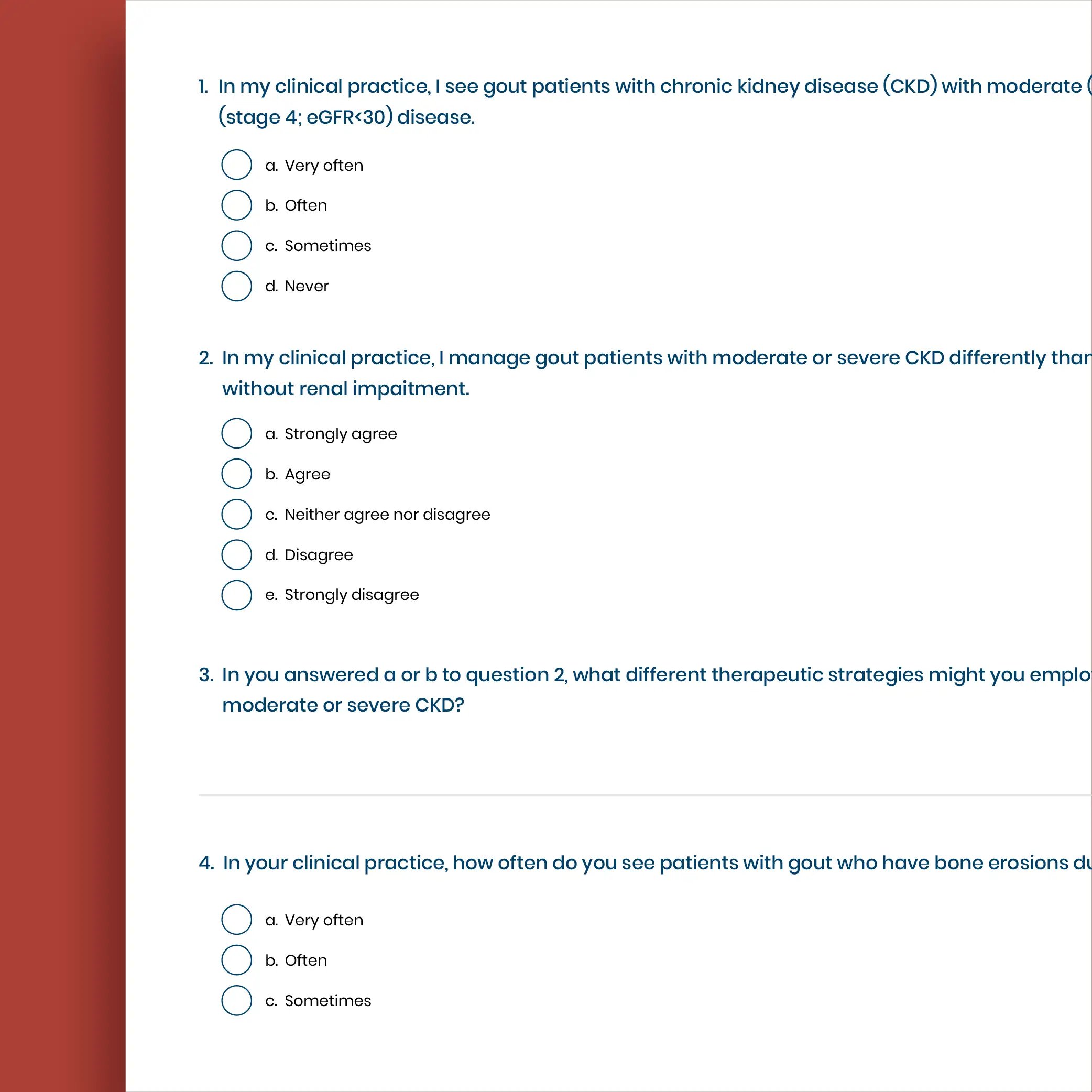
Program managers never have to wonder whether an attendee received their confirmation or whether a speaker got their logistics details.
7. Real-time reporting, dashboards and AI-powered insights
Let’s linger on the data piece here, given all the AI tooling that’s available now for ingesting and analyzing information.
The data generated by speaker programs is enormously valuable, but only if you can access it in (near) real time and make sense of it. Too many organizations compile attendance lists and expense reports manually after the fact, producing reports that arrive too late to inform strategic decisions and take significant staff time to assemble.
-
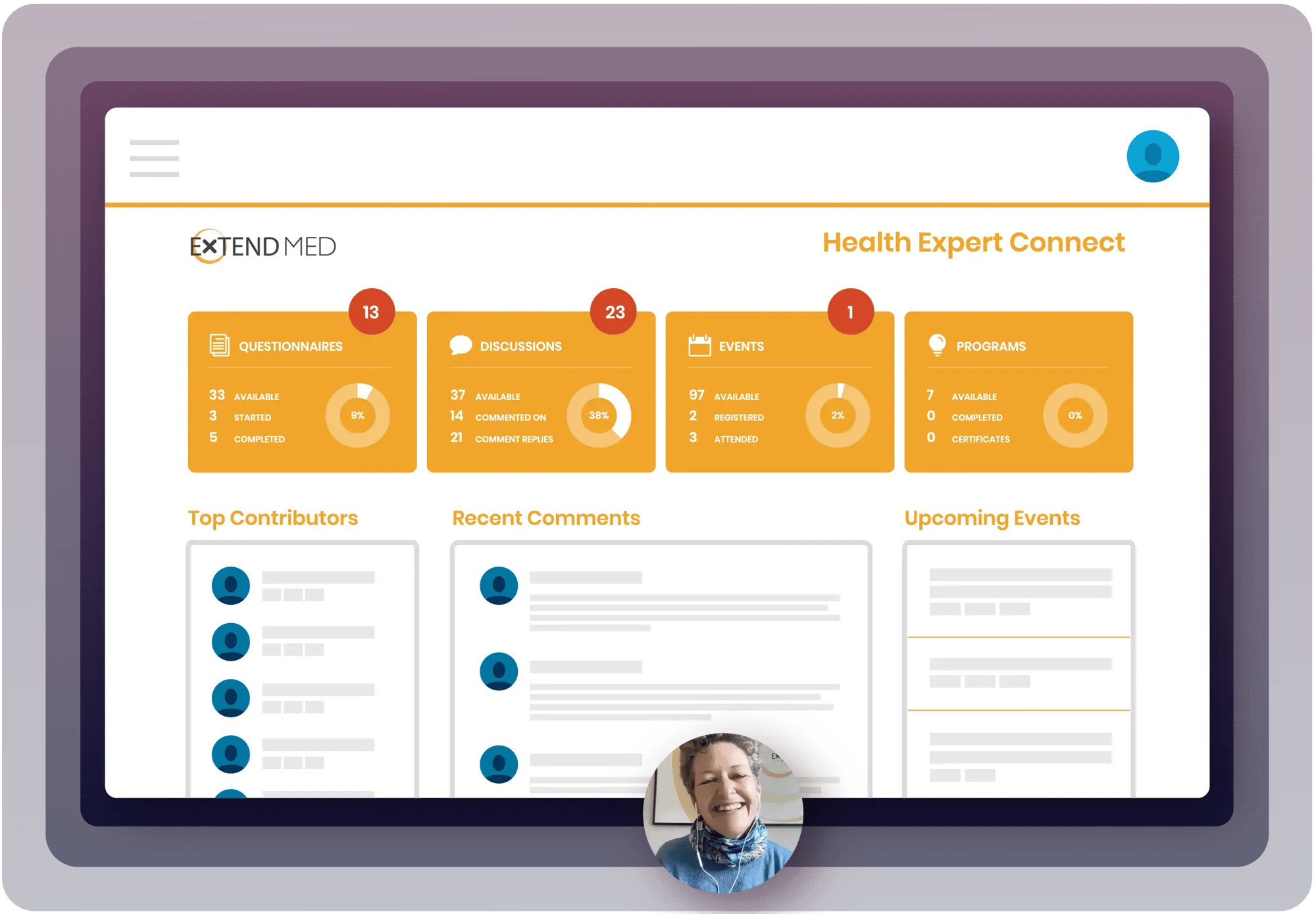
A platform should give you real-time dashboards showing attendance trends, aggregate spend against budget, speaker utilization rates, expense categorization and program completion status.
-
It should let you generate executive-ready reports that different stakeholders need.
-
Field leaders want regional performance views, compliance teams want spend summaries, and commercial leadership wants ROI metrics that connect program activity to business objectives.
The best platforms are also incorporating AI-powered analytics that go beyond simple dashboards, so you’re not doing disconnected dumps into off-the-shelf LLMs to pull insights from.
Look for capabilities that can proactively surface operational insights—identifying reps with high cancellation rates, flagging programs that are taking longer than average to set up, highlighting regional performance differences, and analyzing registration-to-attendance conversion patterns to optimize timing and outreach.
A plethora of (actually) useful reporting
We provide comprehensive, templatized reporting on attendee details, speaker utilization, rep evaluations, expense breakdowns and compliance metrics—all downloadable and sortable.
Our dashboards show real-time program status, spend tracking by category and deliverability metrics for all platform communications.
But what we’re most excited about is where we're heading with AI-driven insights.
We're integrating artificial intelligence to proactively call out operational issues, alerting you when a rep has canceled more than a couple of programs, flagging programs that are taking longer than average to book and set up and analyzing which programs are generating the highest engagement.
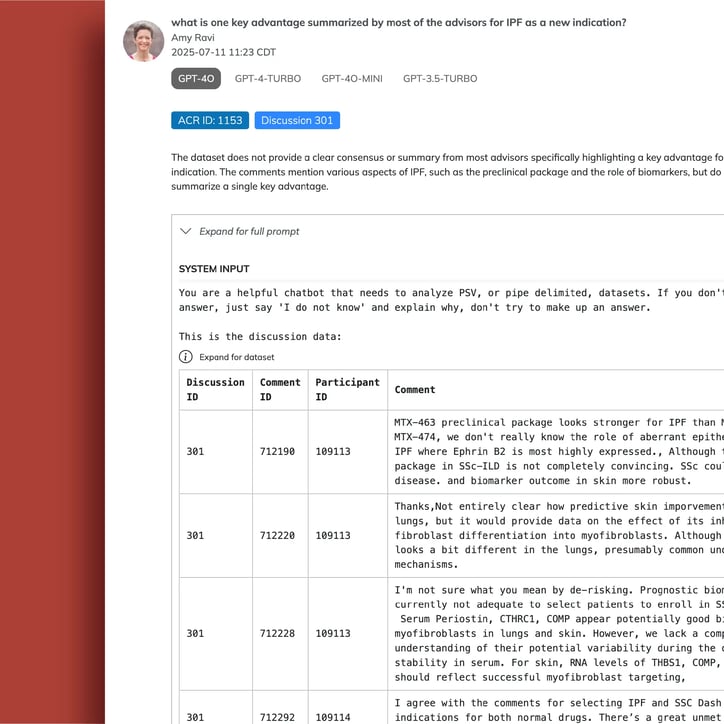
We're working toward sharing best practices with our clients about when to send registration invitations for maximum attendance conversion, which regions are running the most effective programs, and where operational bottlenecks are hiding.
8. Flexible deployment models: full service, platform license or both
This is a critical point that many organizations overlook during platform evaluation. Not every team wants the same level of involvement.
- Some pharma teams want a fully managed solution: hand it all over to a partner and focus on strategy.
- Others, especially those running ~200 or more programs annually, want to drive the platform themselves with their own team.
- And many med comms agencies want to license the technology, white-label it, and operate it on behalf of their clients.
The platform you choose should accommodate all of these models without forcing you into a one-size-fits-all engagement. Look for providers that offer full-service management (where the provider handles all aspects of program execution), a self-directed platform license (where your team operates the technology independently with training and support) and hybrid models where you can start with full-service support and gradually transition to self-directed operation as your team builds capability.
Also, look at contract flexibility. Many enterprise platforms require year-long commitments with rigid pricing. If you're a smaller biotech or a mid-sized pharma company, that's a significant bet to make before you've validated the platform's fit.
Providers that offer short-term pilot programs with full tracking and reporting enable you to prove ROI before scaling and we firmly believe that's a much healthier way to start a technology relationship.
Use the model that fits you
We've built our platform around this exact flexibility.
-
Clients can choose full-service management, where our team handles everything from speaker contracting to final Sunshine exports, or they can license the platform and run it independently.
-
We also support hybrid models where we provide initial setup and training, then step back as the team becomes proficient.
For organizations running large-scale programs (200+ events annually), our platform rental model provides a cost-effective way to leverage our full technology infrastructure while maintaining direct control. And we offer flexible contract terms, including the option to start with a short-term pilot project (no year-long commitment required until you've seen the results yourself).
This flexibility extends to what you license, too. You can use the full platform or license-specific modules for a subset of your programs: virtual-only, congress-related, a single brand or region. We'll build a solution that matches your needs and resources, not the other way around.
9. Integration and implementation
No “platform” operates in isolation. Your speaker program platform needs to work with the other systems your organization relies on:
- Your CRM for field team coordination.
- Your expense management tool for financial reconciliation.
- Your compliance systems for aggregate spend reporting.
- Your e-signature tool for contract execution.
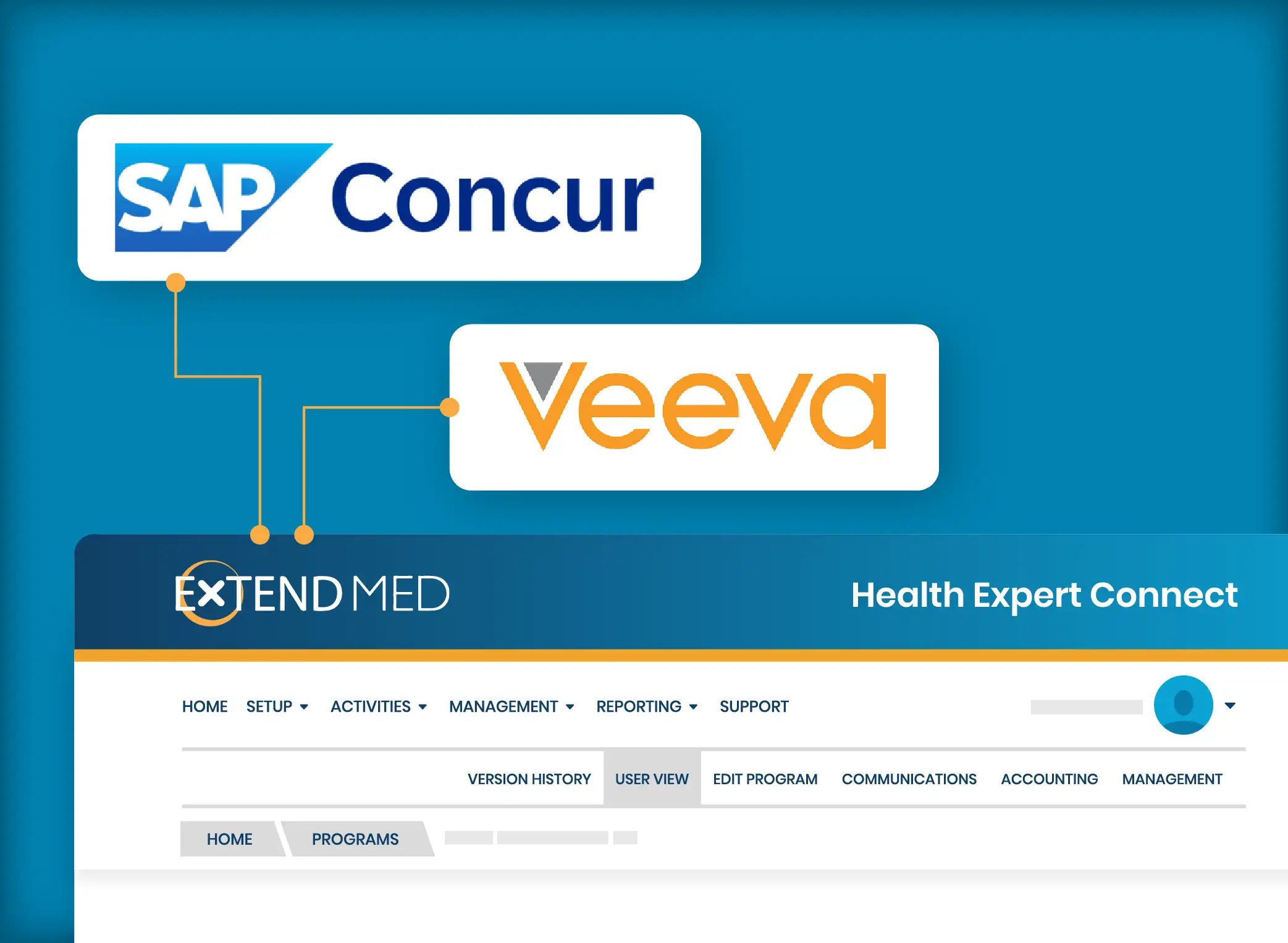
Look for a platform that supports integrations with common enterprise systems like Veeva, Salesforce, and Concur, and that offers native integration with e-signature tools like DocuSign.
Also evaluate whether the platform integrates with Google Maps for venue selection (a surprisingly impactful feature for field rep workflows) and whether it supports export formats compatible with your CMS Sunshine reporting pipeline.
The key question isn't whether a platform can integrate; most can, eventually, sort of. The key question is whether the integration is built into the platform's standard architecture or whether it requires custom development work and long timelines. For enterprise clients, pre-built integrations save months of implementation time. For smaller organizations, they mean you don't need an IT team to get up and running.
All the integrations you need
Our platform integrates with DocuSign for contract execution, Google Maps for venue selection, and supports connections with Veeva, Salesforce, and Concur for enterprise clients. Compliance data exports are formatted for CMS Sunshine reporting pipeline compatibility.
And we've designed the platform so that non-technical teams can use it without IT support. Most clients are up and running within 30 to 45 days of initial setup.
Implementation and onboarding
A platform is only useful once it's running, and the gap between signing and going live is where a lot of technology relationships stall. The questions to ask aren't only about features. They're about how you get from today to a working program, and who's responsible for getting you there.
Look for a provider that handles onboarding directly rather than handing you documentation and wishing you luck.
-
Ask whether the platform needs IT involvement to stand up.
-
Ask what training looks like for the different people who'll touch it: your internal team, your field reps and your speakers all use it differently.
-
And ask whether you can start small, with a single brand or region, before committing the whole program.
Most of our clients are up and running on Health Expert Connect™ within 30 to 45 days, and the platform is built for non-technical teams, so you don't need IT to implement it.
Every client gets white-glove onboarding and a dedicated program manager who stays with you past go-live. We train your internal team, your reps and your speakers directly, and we back that up with on-demand how-to guides and user documentation.
If you're not ready to move everything at once, you can start with a pilot on a single brand or region with full tracking and reporting, prove it works and scale from there. For teams worried about adoption, we offer fully-managed pilots and hands-on rollout support, so the change doesn't land entirely on your team.
10. A strategic partner (if you want), not just a software vendor
This is the one that's hardest to evaluate during a sales process, but it might be the most important factor of all for many teams.
Speaker bureau management is complex enough that technology alone isn't sufficient. You need a partner who understands the nuances of pharmaceutical engagement programs—someone who has managed these programs themselves, who understands compliance requirements at a practical level, who can advise on operational best practices and who will actively collaborate with your team to solve problems as they arise.
The difference between a software vendor and a strategic partner shows up in the day-to-day:
- A vendor gives you a login and a support ticket system.
- A partner assigns you a dedicated program manager who knows your programs by name.
- A vendor tells you to submit a feature request. A partner says, "Good idea, we'll work that in, in the next couple of weeks."
- A vendor sells you the same platform they sell everyone else. A partner customizes workflows, builds dashboards around your specific KPIs, and joins your client pitches when it would help.
For agencies in particular, this distinction is critical! The right platform partner doesn't just give you technology; they give you a seat at the table in strategic discussions. They co-create solutions that help you win new business and deliver on the business you already have.
A team of speaker program strategy and management experts
Every client gets a dedicated program manager for development, implementation, training, and ongoing support.
But what makes our approach different is that we don't stop at technical support. We actively propose strategic ideas: new dashboard concepts, forecasted versus actual savings analyses and operational efficiency improvements.
We join client pitches when it helps. We build how-to guides when we notice recurring questions. We customize workflows to match your SOPs, not the other way around.
Jaime Arvizo, Vice President and Head of Medical Affairs at Ultragenyx, described it this way:
"In 25 years of working with vendors, ExtendMed stands at the top of the list. They're strategic partners, arming my staff with vital statistics and sharing their experience and ideas for the future. They're nimble and they understand our business. They've anticipated issues, recommended new directions and implemented our decisions efficiently."

11. Accessibility and pricing that doesn't exclude smaller orgs
There's an uncomfortable truth in this market that we are attacking directly: Some of the most well-known engagement platforms are really only viable for large, established pharma companies that can afford their subscription model and all the associated costs.
For smaller biotechs moving their pipelines from Phase II to Phase III, for emerging pharma companies launching their first commercial speaker program, and for med comms agencies serving smaller clients, those platforms are simply cost-prohibitive.
This creates a real gap. Smaller organizations that need sophisticated speaker program infrastructure (like compliance tracking, FMV enforcement, attendee management, Sunshine reporting) often can't access it. They're forced to run programs with manual tools that create the exact compliance risks they can least afford.
A platform's pricing and engagement model shouldn't be a barrier to entry. Look for providers that serve small to mid-sized organizations with the same rigor they bring to large enterprise accounts and that offer pricing models proportionate to your program volume and complexity.
A refreshingly flexible model for small and large teams
This is a principle we feel so strongly about. Our model and price points allow smaller biotechs and emerging pharma companies to access the same caliber of program management infrastructure as large pharmaceutical teams.
We're not an enterprise SaaS subscription that prices out half the market. We work with organizations of all sizes, and we build pricing around what makes sense for your specific program needs.
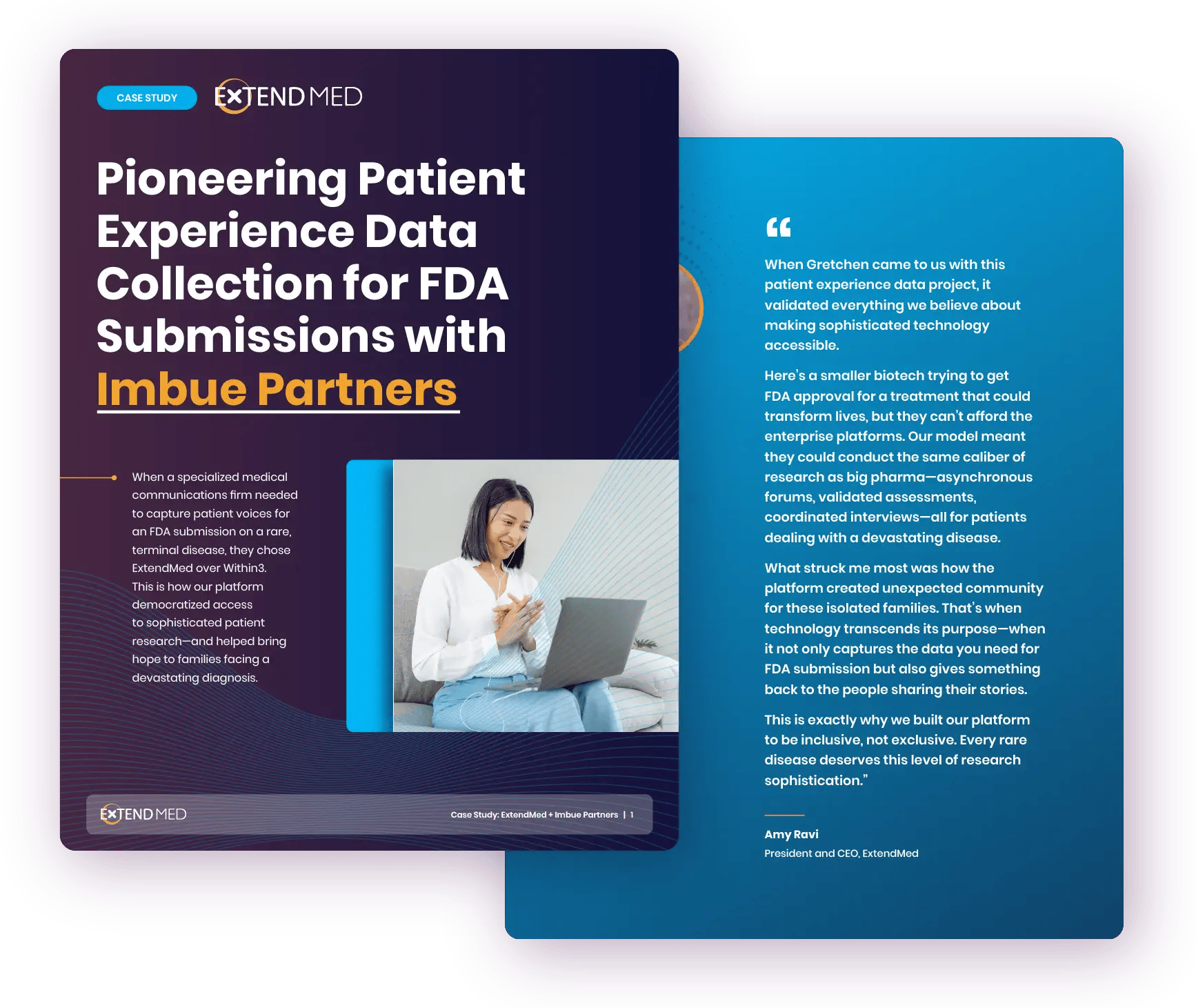
Gretchen Hover from Imbue Partners chose us over Within3 for exactly this reason when she needed to conduct patient experience research for an FDA submission on behalf of a smaller biotech client. As she told us:
"Within3 is really only viable for large, established pharma companies. For smaller biotechs, it's simply cost-prohibitive."
She chose our platform because our model is fundamentally more inclusive, and the result was groundbreaking patient experience data that directly supported an FDA submission for a rare disease treatment.
Every organization that runs speaker programs, regardless of size, deserves access to proper compliance infrastructure and operational tooling. That's a conviction, not a marketing message.
📄 Read our full case study with Imbue Partners »
Turning this into your evaluation
If you're choosing a platform, it helps to turn the criteria above into a short scorecard rather than a feelings-based comparison after a few demos. You could even build an RFP from it (and send it to us, please!).
Here's a practical way to do it: Separate your requirements into must-haves and nice-to-haves before you see a single demo.
A must-have is something that, if the platform can't do it, takes the platform out of the running. A nice-to-have is something you'd value but could live without. Doing this first keeps a slick demo from talking you into priorities that aren't really yours.
| Likely must-haves | Likely nice-to-haves |
| End-to-end lifecycle management in one system | AI-driven operational insights |
| Automated FMV tracking, NPI validation and Sunshine-ready exports | A dedicated speaker portal |
| Customizable approval workflows that match your SOPs | In-meeting engagement tools |
| A full audit trail for every program action | |
| Compliance exports compatible with your CMS reporting pipeline |
Then take it into the vendor conversation with specific questions instead of general ones. A few worth asking any platform you evaluate:
- Which parts of the program lifecycle do you handle natively, and which do I have to manage elsewhere?
- How do you enforce my FMV caps and speaker utilization limits, and at what point in the process?
- Can I configure approval workflows to match my SOPs without custom development?
- What can I prove in a pilot before signing a longer commitment?
- What's live in the platform today versus on your roadmap?
- What does implementation involve, and how long until I'm running real programs?
The right platform should welcome these questions and answer them concretely. Vague answers are an answer in themselves!

Final thoughts and next steps
Speaker bureau management demands more than a meeting platform with some reporting bolted on. You need a comprehensive system that manages the full program lifecycle, enforces compliance at every step, empowers your field teams and speakers, generates actionable insights, and adapts to how your organization actually works.
Whether you're a pharma company running programs directly, a biotech building your first bureau, or a medical communications agency managing programs across multiple clients, the checklist above represents what you should expect from a modern speaker bureau platform, not aspirationally, but practically, right now.
We built ExtendMed's Health Expert Connect™ platform over 20 years of working alongside the teams who do this work every day. If any of what I've described resonates with the challenges you're facing, I'd welcome the conversation to hear how we might partner to solve your current challenges. No pressure. No long-term commitment required. Just a practical discussion about how we might help.
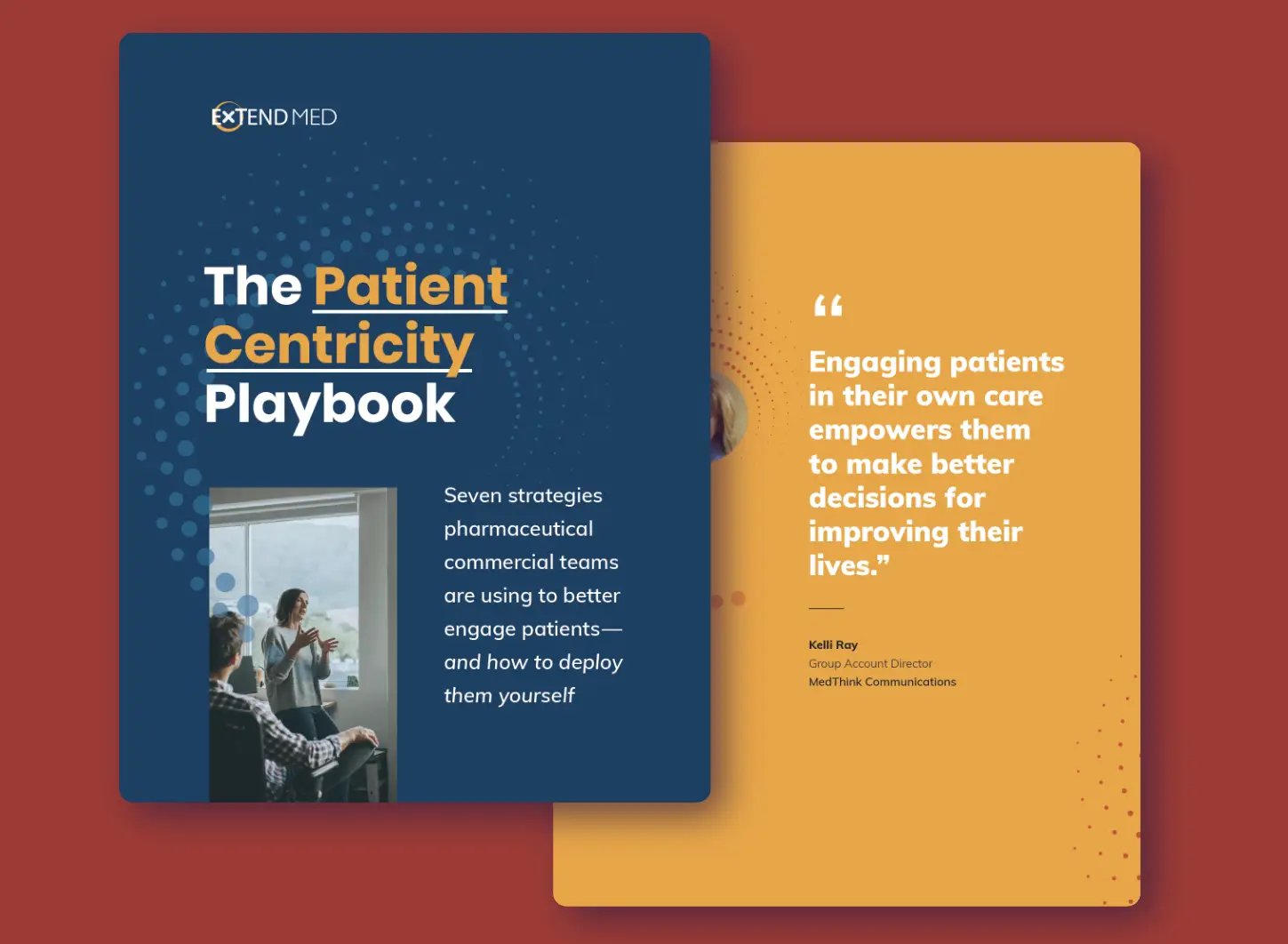
📄 Free White Paper
The Patient Centricity Playbook
Seven strategies pharmaceutical commercial teams are using to better engage patients—and how to deploy them yourself